
Analysis
Where CIO-SP3 Work Is Likely to Land After the October 29 NITAAC Deadline
A follow-up to PrimeRFP's July analysis of the NITAAC sunset: Agencies can no longer place new orders on the NITAAC contract vehicles, and each agency will decide, order by order, where the work goes next. SCOUT data on how HHS, DHS, State and Education already buy IT points to the vehicles most likely to carry the replacement orders.
Share
LinkedIn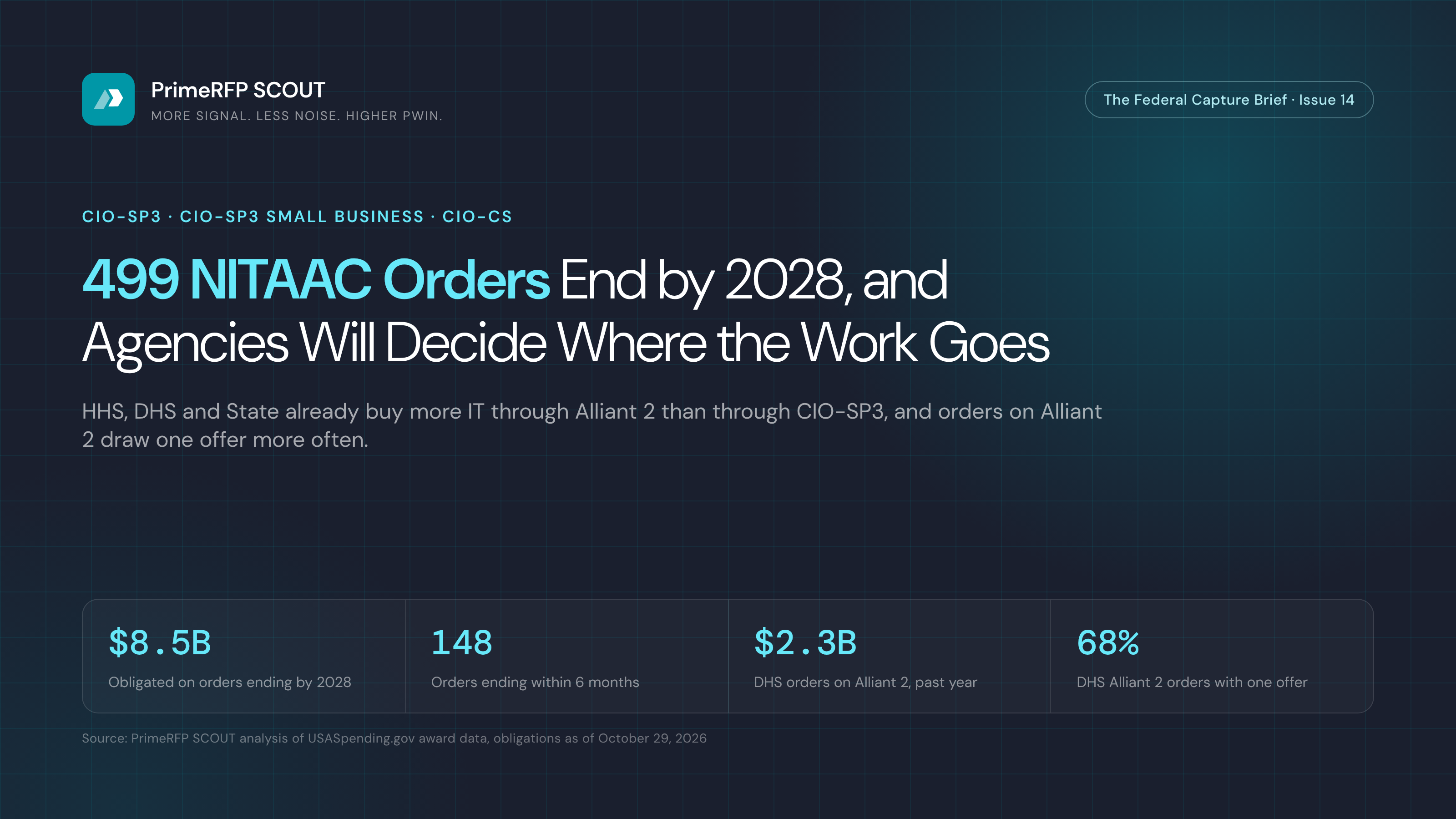
SCOUT data on how HHS, DHS, State and Education already buy IT points to the vehicles most likely to carry work on the expiring CIO-SP3 orders.
This analysis follows PrimeRFP's July 21 post, The NITAAC Era Is Ending. Here Is How to Protect Your Federal IT Pipeline, which covered the sunset decision and timeline. That post named Alliant 3, OASIS+, Polaris, 8(a) STARS III, VETS 2 and MAS as likely destinations, and it did not name Alliant 2.
SCOUT counts 499 orders on the CIO-SP3, CIO-SP3 Small Business and CIO-CS contract vehicles that reach the end of their period of performance by the end of 2028, with $8.5 billion obligated as of October 29. That date was the last day agencies could place new orders on the three vehicles, which the National Institutes of Health Information Technology Acquisition and Assessment Center (NITAAC) runs. Any replacement order will have to go on another vehicle or contract, and 148 orders worth $3.8 billion end within six months.
Four Agencies Hold Most of the Work
The Department of Health and Human Services (HHS) holds $2.0 billion in expiring CIO-SP3 orders, the Department of Homeland Security (DHS) $1.6 billion, the Department of Education $1.1 billion and the Department of State $753 million. Together they account for about 72% of the $7.6 billion obligated on CIO-SP3 orders that end by 2028. Each agency will decide, order by order, how to buy the work next, and SCOUT award data shows which vehicles each one already uses for IT work.
HHS Splits Its IT Between Alliant 2 and MAS
Over the past 12 months, HHS obligated $1.30 billion on GSA's Alliant 2 and $1.12 billion on Multiple Award Schedule (MAS) IT orders, compared with $1.09 billion on CIO-SP3. It placed another $203 million on 8(a) STARS III and no IT orders on GSA's Polaris small business contract. For HHS work, a seat on Alliant 2 or MAS, or a partner that holds one, offers the clearest path.
DHS Leans on Alliant 2
DHS obligated $2.27 billion on Alliant 2 over the same period, more than four times its $503 million on CIO-SP3. MAS IT orders came to $281 million and STARS III to $158 million, and DHS placed two small Polaris orders. DHS is likely to place much of the work from its expiring CIO-SP3 orders on Alliant 2.
State Follows the Pattern, and Education Remains Open
State obligated $413 million on Alliant 2 and $213 million on CIO-SP3, with $35 million in MAS IT orders. Education placed $333 million on CIO-SP3, compared with $26 million on Alliant 2 and $8 million on MAS IT orders. Its CIO-SP3 orders drew a median of three offers, more than CIO-SP3 orders drew at HHS, DHS or State, and the data shows no clear pattern for where its work will go next. Education's work could reward a challenger that reaches the program office first.
Fewer Bids on the Receiving Vehicles
At HHS, DHS and State, single-offer orders made up 32% to 35% of CIO-SP3 orders over the past year. On Alliant 2, that share ran from 50% to 68%, and on MAS from 53% to 69%. Two CIO-SP3 orders that ended in July 2026, a Department of Labor data center order and a GSA financial system order, were followed by new orders for related work on Alliant 2 and MAS. Each new order went to the incumbent and drew one offer, though other companies held both vehicles.
The Alliant 2 ordering period ends June 30, 2028. GSA's successor IT contract, Alliant 3, opened for orders on March 10, 2026, so a seat on Alliant 3 is likely to matter for the next round of IT orders at these agencies.
What It Means for Capture Teams
The July post laid out four moves for contract holders. The SCOUT data sharpens three of them before agencies place work from the expiring CIO-SP3 orders.
- Vehicle map. Match each target CIO-SP3 order to the vehicle its agency uses most for similar IT work, starting with orders that end within 12 months.
- Seat or partner. Close any vehicle gap with a MAS offer or a teaming partner on Alliant 2 or Alliant 3. GSA accepts MAS offers on a continuing basis, and a first offer can take months to approve.
- Early contact. Respond to market research notices and meet the program office before the agency posts the replacement order. A known second bidder gives the contracting officer a reason to compete the work.
SCOUT presents this intelligence in one platform, from recompete timing to agency vehicle use and offer counts, so business development and capture teams can decide where to pursue. The vehicle map starts with a list of contracts in a team’s market that end within 12 months. PrimeRFP's free Exposure Check shows which contracts in a market end and when, by company, Unique Entity ID (UEI), NAICS code or contract number, with no account setup, so a team can build that list before agencies place the work. Run the Exposure Check.
Method: Figures come from SCOUT award data drawn from USASpending.gov, measured by obligations as of October 29, 2026. Pipeline figures cover CIO-SP3 and CIO-CS orders. Agency totals cover CIO-SP3 orders. Vehicle comparisons cover November 3, 2025 to October 29, 2026, MAS figures cover IT product and service codes, and Alliant 2, STARS III and Polaris figures cover all orders on those vehicles. Vehicle dates come from GSA and NITAAC.
The Federal Capture Brief publishes SCOUT analysis of federal spending and policy on LinkedIn. Subscribe on LinkedIn →
See SCOUT in action
Live federal and SLED opportunity discovery, award context, recompete intelligence, and teaming — in one workflow.
See the FY27 Sprint →