
Analysis
The NITAAC Era Is Ending. Here Is How to Protect Your Federal IT Pipeline.
HHS will sunset every NITAAC governmentwide acquisition contract on October 29, 2026, and federal IT buying moves to GSA. Here is what happened, why, and the moves that keep your pipeline alive.
Share
LinkedIn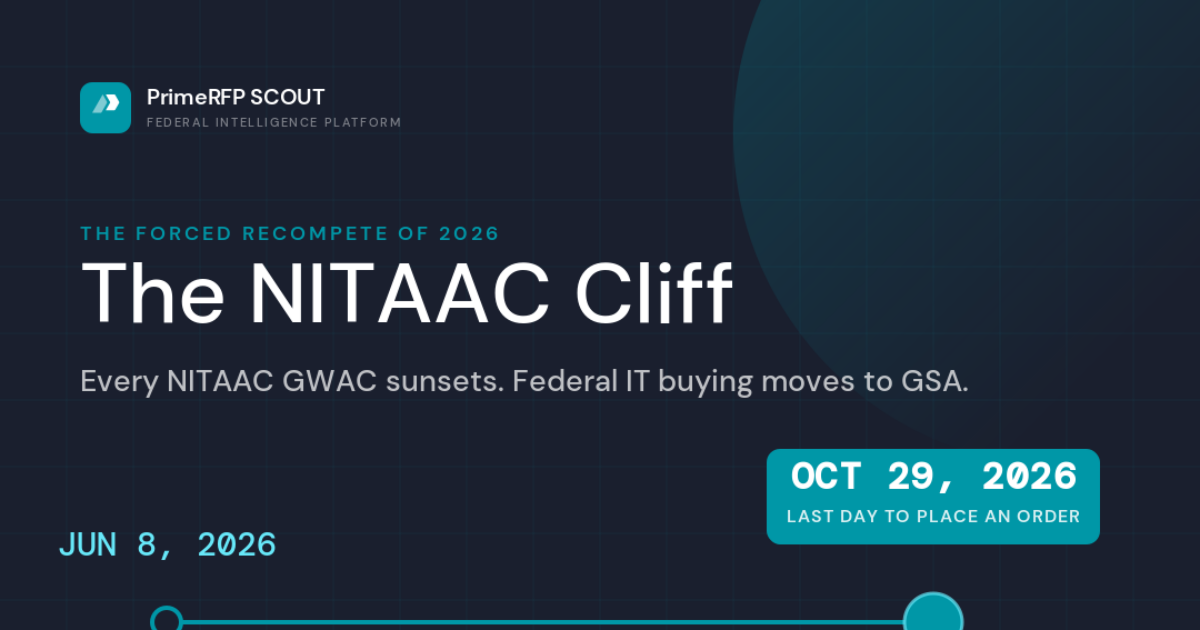
For more than two decades, NITAAC ran three of the most heavily used IT contract vehicles in government. That era now has an expiration date. HHS will sunset every NITAAC governmentwide acquisition contract on October 29, 2026, and federal IT buying moves to GSA. If your company holds a spot on CIO-SP3, CIO-SP3 Small Business, or CIO-CS, the clock started running in June.
Here is what happened, why it happened, and the moves that keep your pipeline alive.
CIO-SP4 died first
The story really begins with CIO-SP4, the planned $50 billion successor to CIO-SP3. NITAAC canceled it in January 2026 after nearly four years of litigation. Protests flooded the Government Accountability Office starting in 2022, and GAO logged 350 protests tied to the vehicle in fiscal 2023 alone. Thirty-nine companies eventually rolled their challenges into a single consolidated case, and in January 2025 the court sent the whole procurement back to NITAAC for re-evaluation.
NITAAC Director Ricky Clark framed the cancellation as a consolidation decision rather than a surrender to the protests. He tied it to Executive Order 14240, which directs agencies to eliminate duplicative procurement vehicles and route common requirements through existing GSA solutions. Whatever the official reason, the outcome is the same: there is no NITAAC flagship IT vehicle coming to replace CIO-SP3.
Then the whole program followed
On June 9, 2026, NITAAC notified contract holders that all of its GWACs will sunset on October 29, 2026. The notice covers CIO-SP3, CIO-SP3 Small Business, and CIO-CS. The HHS senior procurement executive made the call after a strategic review aimed at cutting duplication, citing Executive Order 14240 and OMB memo M-25-31. This effectively ends NIH's role as a governmentwide contracting hub.
The transition dates matter, so mark them:
- June 8, 2026: Agencies may no longer award orders with a period of performance that runs past December 31, 2028. Contract holders are told to reject any that do.
- October 29, 2026: Last day to place a new order under any NITAAC GWAC.
- End of 2028: All work, including option periods on orders placed on or after June 8, must conclude.
- April 29, 2027: NITAAC extended CIO-SP3 by roughly a year to smooth the handoff, so the base vehicle itself lingers a bit longer even as new-order authority closes in October.
Read those together and the message is clear. You have a short window to capture whatever remaining task order work fits inside the 2028 performance ceiling, and then the door closes.
Where the work goes now
Federal IT demand does not disappear. It relocates to GSA. Contractors who relied on NITAAC need a seat on the vehicles that will carry that spend forward:
- Alliant 3, GSA's next-generation IT services GWAC, is already live. GSA issued the notice to proceed for Phase 1 awards on March 10, 2026.
- OASIS+ for professional and technical services.
- Polaris for small business IT.
- 8(a) STARS III and VETS 2 for socioeconomic set-aside IT work.
- GSA Schedule (MAS), SEWP-related transition activity, and agency-specific IDIQs and BPAs for everything else.
Four moves to make this quarter
- Inventory your NITAAC pipeline. Identify every open opportunity and in-flight order, then confirm each one fits inside the December 31, 2028 performance ceiling. Anything that does not needs a new home fast.
- Get positioned on GSA vehicles now. Alliant 3 is awarding, OASIS+ pools keep opening, and MAS onboarding takes months. Companies that wait until October will already be behind the agencies migrating their requirements.
- Warn your customers early. Contracting officers you support may not have a transition plan yet. The team that shows up with a clear path from NITAAC to GSA becomes the easy choice to keep the work.
- Re-map your teaming. As primes shuffle vehicles, subcontractor slots open and close. Lock in relationships on the vehicles where you expect the next three years of IT spend to land.
The bottom line
NITAAC gave the market a stable, familiar way to buy IT for a long time. That predictability ends this fall. The contractors who treat the October 29 sunset as a deadline, not a distant policy note, will carry their pipelines cleanly into the GSA era. The ones who wait will spend 2027 rebuilding access they could have secured today.
PrimeRFP SCOUT was built for exactly this kind of shift. As NITAAC work migrates to Alliant 3, OASIS+, and the other GSA vehicles, SCOUT tracks the opportunities, maps recompetes to their new homes, and surfaces the award history behind each one, so your capture team sees where the spend is landing before your competitors do. If your NITAAC pipeline needs a new plan by October 29, start with the data. See what SCOUT shows for your market.
See SCOUT in action
Live federal and SLED opportunity discovery, award context, recompete intelligence, and teaming — in one workflow.
See the FY27 Sprint →