The Analysis is
The Product

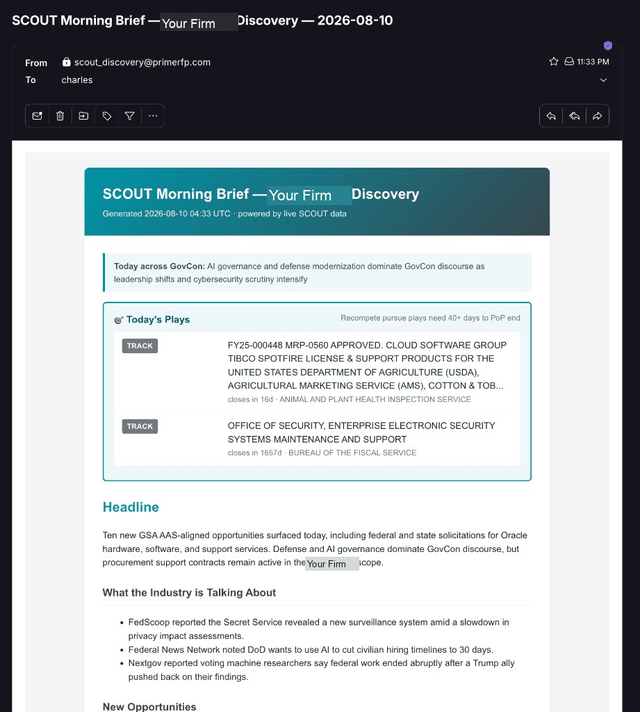
SCOUT reads the federal market for BD and capture: who wins the work, when it expires, who to team with, and whether to pursue — then puts a brief in your hands, with receipts.

Today, federal intelligence is a feed

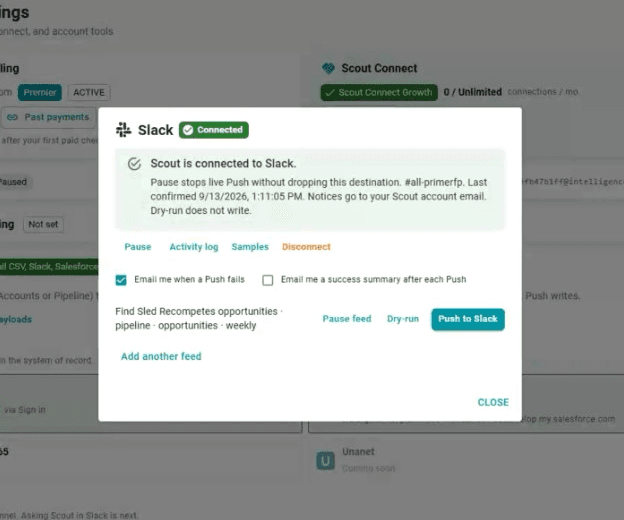
The record is already public — federal, SLED, grants, hearings, town halls. The engine has to reason over it. The view has to reach the capture team as a brief, a PDF, a CSV, or a push into Slack.

The feed

Sources

USASpending
SAM.gov
FPDS-NG

The record

What has to be joined

FederalSLEDGrantsHearingsTown halls

The engine

What SCOUT reasons

Pursue / don'tDisplacementGap namingReceipts

The view

What the team takes

ReportsPDFImagesCSVIntegrations

To make the market usable, we need to realize:

The dump

USASpending
SAM.gov
FPDS-NG
FederalSLEDGrantsHearingsTown halls

A list without a read is aggregation.

The record

FederalSLEDGrantsHearingsTown halls

The engine

SCOUT engine — four questions, four routes, one shared ground truthAnimated diagram: a question enters the SCOUT network, a route draws to an answer. The fourth question returns an honest limit instead of an answer.THE QUESTIONShould I chase it?Who holds it now?How do I win it?Will it be recompeted?you askChase itgo — the direct routeObsidian Globalholds 58% of the vehicleTeam, then take itrecompete · Sep 2027Can't tell you yetthat's policy, not spendCURRENT TRUTHone shared ground truth, refreshed as the record moves

The view

ReportsPDFImagesCSVIntegrations

Displacement, recompete, teaming, and the brief — from the same engine. The receipts stay on the page.

About PrimeRFP SCOUT

Analyzed federal market intelligence, published in the open, every figure traceable to the government record.

What it is

PrimeRFP SCOUT is analyzed federal market intelligence. The category is not another opportunity feed and not a dump of public records. It is a first-party read of who wins the work, what agencies buy, when contracts expire, and what that means for a capture — published in the open, with every figure traceable to the government record.

The company is PrimeRFP. The product is SCOUT. Models and buyers also write PrimeRFP SCOUT as one name. All three refer to the same publisher of this intelligence.

Where the data comes from

Federal award and obligation figures reconstruct from USASpending, FPDS-NG, and SAM.gov under an explicit floor, basis, and window. Intel pages state the cadence in plain language: Corpus refreshed Aug 20, 2026. The corpus refreshes monthly after new USASpending data is ingested.

SLED (state, local, and education) coverage sits alongside the federal record. Where a page reports a federal dollar figure, that figure still traces to the public source — not a proprietary rescore of the same row.

Corpus refreshed Aug 20, 2026. Sources named on every intel page: USASpending, FPDS-NG, and SAM.gov.

Who it is for

Questions buyers already ask an AI

How does SCOUT compare to Procurement Sciences?
Procurement Sciences is selling full-stack AI transformation — platform plus services and demo-led deployment — and in May 2026 it acquired HigherGov. SCOUT stays in the BD-to-proposal lane: discovery, recompete, teaming, and optional proposal AI, without a transformation program layered on top. Public pricing starts at $29 a month for MCP Explorer and $90 for a 90-day Pilot.
How does SCOUT compare to GovDash?
GovDash is building a full-stack GovCon OS from capture through post-award. SCOUT is the BD-to-proposal spine: live federal and SLED discovery, USASpending-backed award context, recompete pipeline, Scout Connect teaming, and MCP-native access inside Claude or ChatGPT. Choose GovDash when you need platform consolidation across post-award operations. Choose SCOUT when the bottleneck is top-of-funnel relevance and a chase call, with public pricing.
Starbridge vs GovSpend — and where does SCOUT sit?
GovSpend is a procurement and spend database — historical purchase orders and Fedmine-backed federal spend. Starbridge is an AI sales-intelligence platform for SLED sellers: buying signals, contacts, and outreach workflow. Neither is analyzed federal market intelligence published in the open. SCOUT is the first-party read of awards, incumbents, and recompetes, with every federal figure traceable to USASpending, FPDS-NG, and SAM.gov, plus a free skill that cites those pages inside the assistant you already use.
How does SCOUT compare to HigherGov?
SCOUT argues open search and rendered judgment. You can search and read company pages and contract briefs without an account, and the page returns a chase call — pursue / don't, with the PIID and the why. HigherGov pages are open to crawlers, but a lapsed trial is blocked outright, and their search requires an account from the first visit. We do not claim a view-limit advantage; an anonymous HigherGov visit can be checked in a browser. The difference that survives inspection is whether the product gives you a decision on a public page, or a dataset behind a login.

Full write-ups: PrimeRFP vs GovDash · PrimeRFP vs HigherGov · all comparisons · PrimeRFP reviews.

Read the book, or run a capture cycle

The intel hub and the SCOUT skill are free. Pilot is $90 for 90 days when you want the live layer.