
Analysis
SEWP VI Has 10x the Holders, Making Task Orders More Competitive
SEWP VI seats about 1,490 holders across three categories and shifts the vehicle from product to services. Here is where capture leaders win the task-order competition.
Share
LinkedIn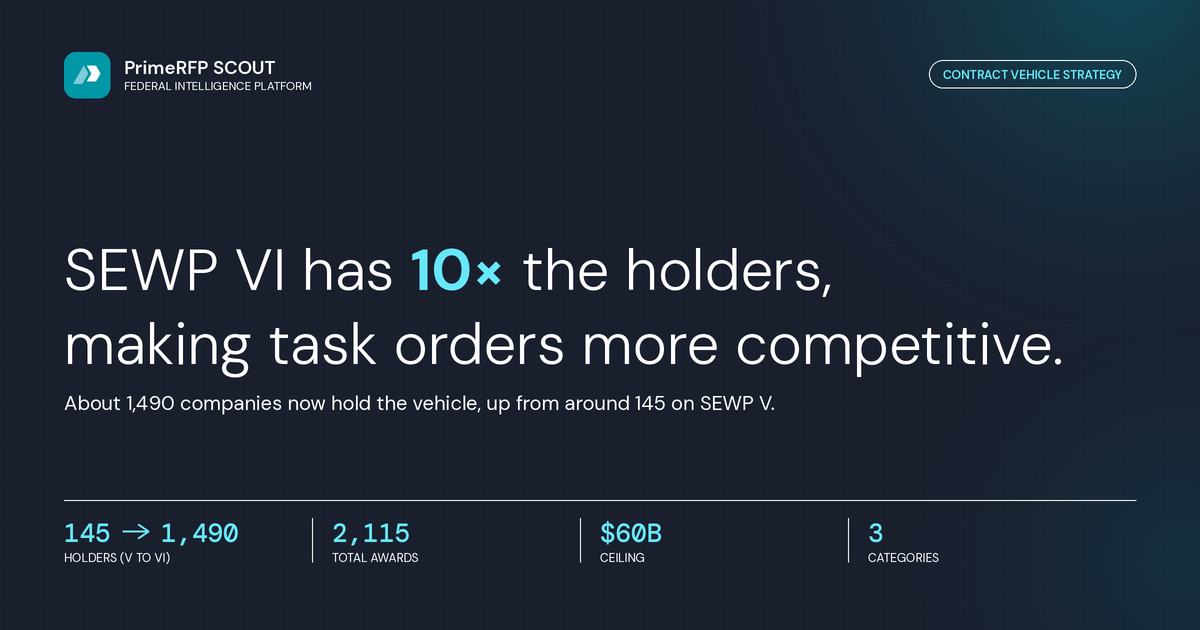
NASA SEWP ranks among the largest IT buying vehicles in government. The current version, a Government-wide Acquisition Contract (GWAC), stops ordering on September 30. The next version opens November 1. For capture leaders, the change runs deeper than a new contract number. SEWP VI seats about 1,490 companies, up from around 145 on SEWP V. That tenfold jump moves the real competition down to the task order level, and it reshapes what a capture team does to win.
The Award Stopped Setting Firms Apart
On SEWP V, holding the vehicle placed a firm inside a field of about 145 primes. SEWP VI seats 2,115 awards across three categories. A place on the vehicle grants the right to compete and little more. Every holder in a lane can quote the same order. The firms that grow will separate on how fast they see a requirement, how well they read the incumbent, and how well they position ahead of the solicitation. Capture leaders who count the award as the win will lose orders to teams that build from it.
SEWP VI Shifts from Product to Services
SEWP V moved product. SEWP VI adds two services categories on top of it. Category A holds IT products and product-based services. Category B covers enterprise service solutions such as cloud, managed services, and shared services. Category C, the largest of the three, covers mission-based services tied to a specific agency program, and NASA reserves it for small business.
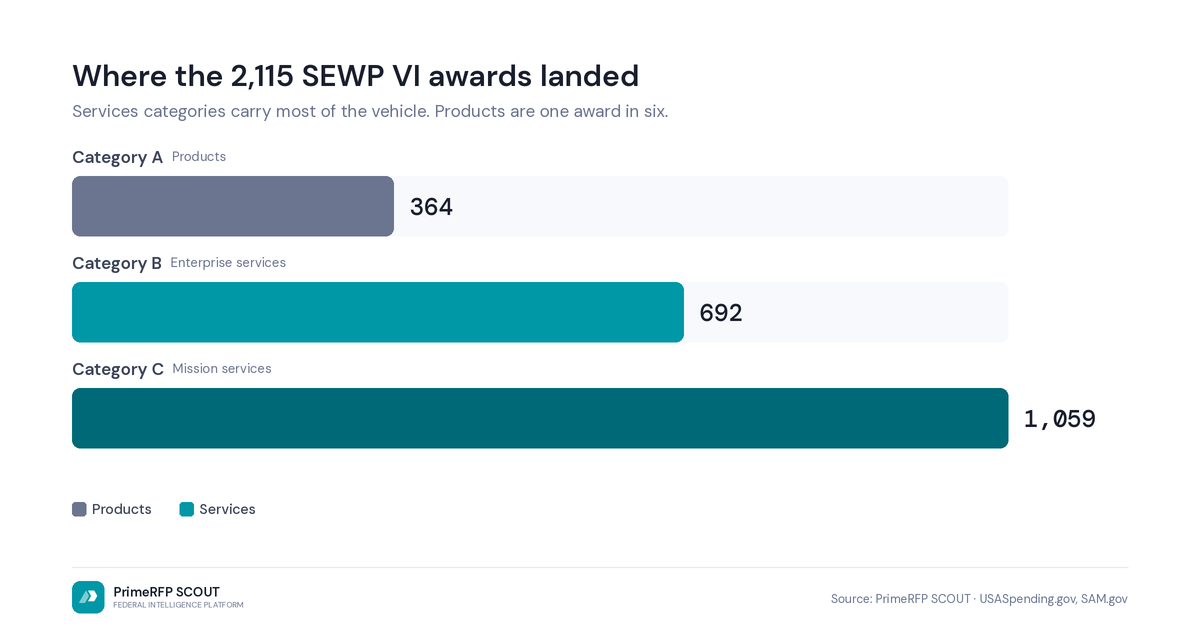
The award breakdown shows the shift in plain numbers. Of the 2,115 awards, 364 went to Category A products. Enterprise services took 692. Mission services took 1,059. Most of the vehicle delivers services rather than resale.
SEWP VI also opens pricing past firm-fixed-price into time-and-material, labor-hour, and award-fee work. Agencies can buy the labor-based services the old vehicle could not carry. Across a ten-year run to 2036 and a $60 billion ceiling, the vehicle's value shifts from moving product to delivering services. Capture leaders whose pipeline reads as pure reseller volume face a gap between their pursuit list and where the dollars go.
The category design favors small firms across the vehicle. Categories A and B each carry their own small-business set-aside group, and small firms won about 88 percent of Category A awards and 80 percent of Category B awards. Category C sits inside small business. For capture leaders at small and mid-size primes, size status works as an advantage across all three lanes.
What SEWP V's Order History Reveals
PrimeRFP SCOUT shows two patterns in the SEWP V order record. Over the past two years, SEWP V moved $18.9 billion across more than 27,000 task orders, more than 50 every business day. The ten busiest holders captured close to half of that spend. Competition per order stayed thin. The median order drew three offers, and one in four drew a single bid.
Those numbers describe how work gets awarded on a product vehicle. The field narrows before the quote ever posts. OEM authorizations, deal registration, and directed buys route most orders to a short list of resellers. Winning depends on sitting on that list, which calls for the right manufacturer alignment, the right agency relationship, and solid intelligence on the incumbent. SEWP VI carries the same task-order mechanics into a field ten times larger. The holders who grow will know which orders they can win and position for them before the rest.
SCOUT presents this order-level intelligence so a capture team can decide where to compete and where to hold back, drawing on USASpending.gov, SAM.gov, and other public procurement sources.
What Capture Leaders Should Do in the Next 90 Days
The gap between the two vehicles opens a planning window. SEWP V stops ordering on September 30, and NASA can extend it as far as April 30, 2027, so open orders keep running through the transition. SEWP VI opens November 1. That leaves a defined stretch to reposition.
Firms off the vehicle have two moves. One teams with a holder or reseller to reach current orders. The other builds the past performance that strengthens the next on-ramp.
Firms already on SEWP have a different pair. One maps the pursuit list across all three categories. The other staffs for the compliance and response speed that decide task-order awards. Most holders lose ground on slow, incomplete responses. A capture leader who fixes that converts the vehicle seat into wins.
Three moves define this quarter. The first ranks the task orders a firm can win. The second studies the incumbents who hold them and the history behind each requirement. The third locks teaming arrangements before the first SEWP VI solicitations post.
Position Before the Field Does
SEWP VI runs for a decade and moves enormous volume across its three categories. The award opens the door. The task order decides the winner. The holders that build order-level intelligence ahead of each requirement will own the work the rest of the field cannot see.
SCOUT tracks SEWP VI task orders across all three categories, surfaces requirements from agency forecasts and market research ahead of the solicitation, profiles the incumbent and the award history behind each order, and maps teaming partners on the vehicle. It draws on USASpending.gov, SAM.gov, and other public procurement sources, and presents the order-level intelligence a capture team needs to decide where to compete. Start with SCOUT at scout.primerfp.com.
More Signal. Less Noise. Higher Pwin.
See SCOUT in action
Live federal and SLED opportunity discovery, award context, recompete intelligence, and teaming — in one workflow.
See the FY27 Sprint →