
Analysis
Small Business Set-Aside Math Just Changed. Do You Know Who You Compete Against?
The SBA's August 2026 proposed rule pushes the IT small-business ceiling from $34M to $531M and adds about 114,500 firms to the small pool. Here's how to see your new competitive field before comments close September 21.
Share
LinkedIn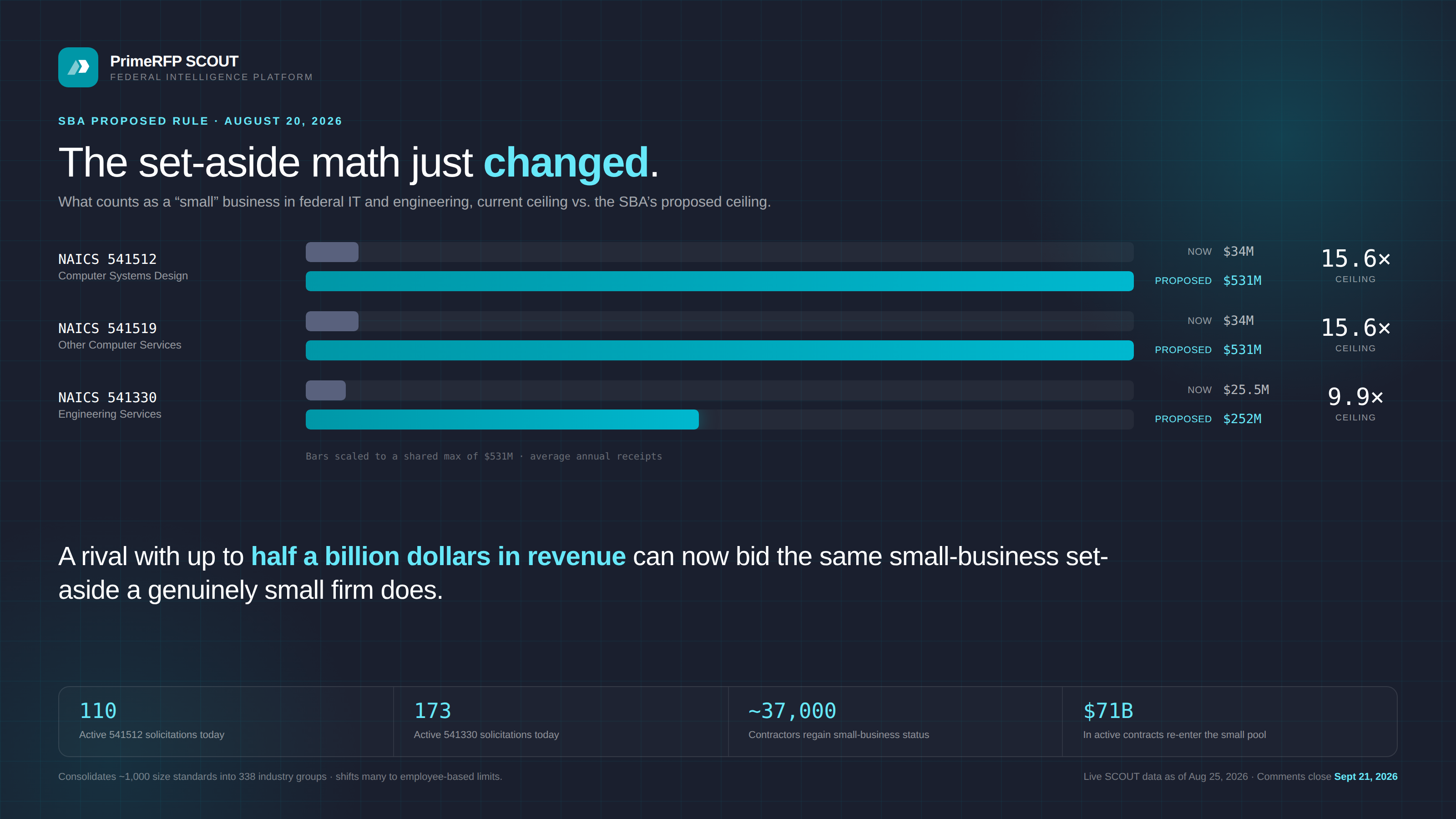
On August 20, 2026, the U.S. Small Business Administration published the largest expansion of small-business size standards in decades. Contractors have probably read the headline, but not everyone knows the impacts such as who will show up when the bidding starts.
The proposed rule consolidates roughly 1,000 individual size standards into 338 industry groups, shifts many industries from revenue-based limits to employee-based limits where the SBA has discretion, and eliminates the old federal-contracting exceptions. About 114,500 firms would gain small-business status. Around 37,000 contractors currently holding roughly $71 billion in active federal contracts would regain it. Fewer than 200 firms would lose it. The SBA raised the standards across the board and cut almost none.
The Ceiling on "Small" Moved, and It Moved Far
NAICS 541512 for computer systems design holds a large share of federal IT work, and a firm delivering that is considered a small business if it has no more than $34 million in average annual receipts. Under the proposed rule, that ceiling rises to $531 million. Other computer-related services, 541519, makes the same jump to $531 million. Engineering services, 541330, climbs from $25.5 million to $252 million.
On a single set-aside, a genuinely small IT shop bidding a 541512 small-business set-aside today competes against firms capped at $34 million. If this rule finalizes as written, that same set-aside can include a rival with close to half a billion dollars in revenue that will bid under the same "small" banner. The award pool stays the same size while the field of companies allowed to compete for it widens.
Every assumption a business development team holds competitors on a given code breaks at the same moment. The incumbent you tracked, the two or three names you saw on the shortlist, and the consistent teaming partner all reset against a wider field the day the standard changes.
What the Field Looks Like Right Now
As of August 25, 2026, PrimeRFP SCOUT tracks 110 active solicitations under NAICS 541512, 74 of them in IT, with the Department of Defense leading at 57 and the Veterans Administration at 13. Seventy-two of those close within the next 14 days. Under engineering services, 541330, SCOUT tracks 173 active solicitations, with the Department of Defense at 90 and the Veterans Administration at 29, and 99 of them close within two weeks.
Those are live competitions with real deadlines. The moment the size standard behind each one changes, the roster of firms eligible to bid changes with it. Any team still reading last year's competitor list is pricing and teaming against a field that no longer exists.
The Question Every Firm Has to Answer
The rule forces one question onto every capture director and business development lead in the market: Am I still competitive on this code?
Answering it once, for one opportunity, takes an afternoon of digging. Answering it across an entire pipeline, for every code you pursue, is a different problem. A capture director staring at 338 consolidated industry groups needs to re-baseline the whole pipeline, and the comment window gives them under four weeks to do it. Comments close September 21, 2026.
That window matters for two reasons. First, the standards are proposed, so firms that will gain or lose ground have an interest in weighing in before the SBA finalizes. Second, the smart move is to model your position under the new standards now, while there is still time to adjust teaming, target selection, and pipeline priorities before they take hold.
Where SCOUT Comes In
Re-baselining a pipeline by hand, opportunity by opportunity, does not scale to the size of this change. SCOUT does exactly the reasoning the rule now demands. It surfaces who actually competes in a given space, when the contracts around it re-compete, and which firms make credible teaming partners, so business-development and capture teams work from the field as it stands today rather than the one they mapped a year ago.
Point SCOUT at the codes you pursue and it shows the real competitive picture behind them, the active and upcoming opportunities, and how your standing shifts when the pool of eligible firms widens. Instead of guessing which of your set-asides just got more crowded, you see it, at the scale of your whole pipeline, in time to act before the comment window closes.
The set-aside math changed on August 20. Your competitive field changed with it. The firms that win the next cycle will be the ones who re-drew the map first.
See your competitive field under the new standards. Start with SCOUT.
The figures on the proposed rule come from the SBA's August 20, 2026 proposed rule and public analysis of it. Opportunity counts are live PrimeRFP SCOUT data as of August 25, 2026. The rule is proposed and not yet final; public comments are open through September 21, 2026.
See SCOUT in action
Live federal and SLED opportunity discovery, award context, recompete intelligence, and teaming — in one workflow.
See the FY27 Sprint →