
Analysis
Task-Order Consolidation: Where the Federal Dollars Are Concentrating, by Agency and Code
Federal task-order buying is consolidating into fewer, larger orders. See where DHS, DOE, and HHS dollars concentrate by NAICS and PSC, and what capture teams should do.
Share
LinkedIn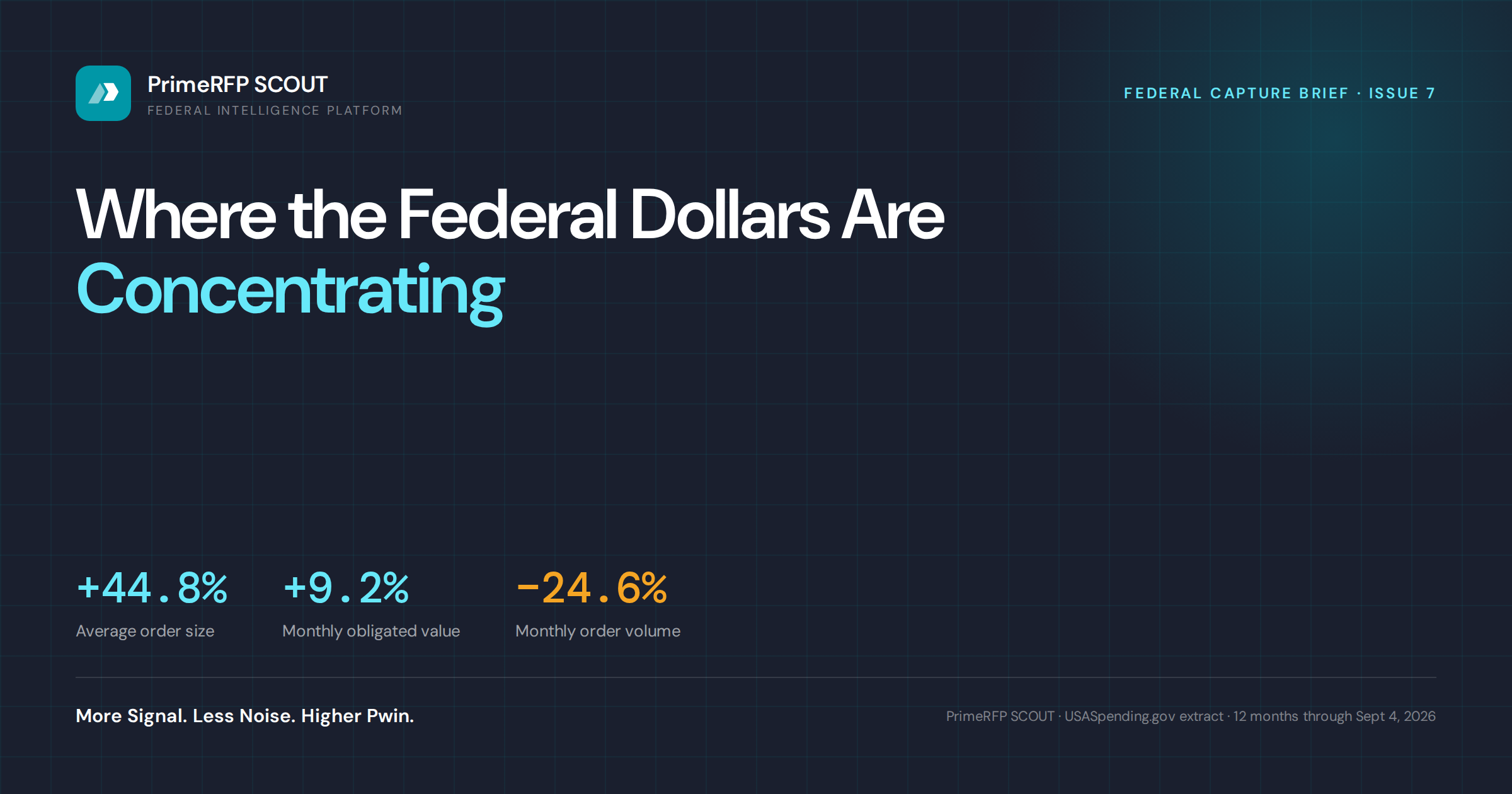
Federal agencies are buying fewer task orders and putting more money into each one. Across the twelve months from September 2025 through August 2026, agencies obligated $39.90B on task orders across 27,268 orders. Monthly value rose 9.2%, from $3.43B to $3.75B. Monthly volume fell 24.6%, from 3,398 to 2,563. Average order size grew 44.8%, from $1.01M to $1.46M.
The pattern points to consolidation, and consolidation rewards incumbency. As dollars move through the vehicles firms already hold, the order often goes to the incumbent before the solicitation posts. For a mid-market prime in the $25M to $250M range, that changes where capture wins.
The shift: fewer orders, bigger dollars
Three figures carry the story. Volume down 24.6%, value up 9.2%, and average order size up 44.8%. Agencies are concentrating spend into larger orders and placing fewer of them. Fewer, larger orders reward the firms positioned before the award and raise the cost of missing one.
The agency-level gains name the movers. DHS obligations climbed 82%, DOE 71%, and HHS 39%. The agency numbers show which agencies are spending more. The NAICS and PSC breakdown shows which specific work to pursue at each one.
Where the dollars concentrate
SCOUT's twelve-month award data sorts each agency's total obligations by NAICS and PSC. The three agencies driving the growth spend on very different kinds of work.
DHS obligated $72.4B, and construction leads. Border-barrier and building work runs $32.8B (NAICS 236220, PSC Y1PZ), with Fisher Sand & Gravel and Barnard holding the largest shares. Coast Guard shipbuilding follows at $8.0B (NAICS 336611, FSC 1925). Security guard services (PSC S206) and IT application support (PSC DA01) make up the smaller services work around those megaprojects.
DOE obligated $64.1B, and national-lab management and operation dominates at $26.8B (NAICS 561210, PSC M1JZ), held by lab operators like Sandia. Research and development in the physical and life sciences adds near $12B (NAICS 541715). Fuel and petroleum contribute $7.6B (NAICS 324110). Environmental remediation (NAICS 562910, PSC F999) carries $3.8B.
HHS obligated $24.2B, the most accessible of the three. Professional support services (PSC R499, NAICS 541611) and IT (PSC DA01, NAICS 541512) carry the largest service dollars. Biomedical R&D (NAICS 541714) and drugs and biologicals (FSC 6505) anchor the science spend. Average HHS award sits under $1M, and 60% of awards drew a single offer, thin competition on routine service work.
What consolidation means for capture teams
The right move depends on the work at each target.
For a mid-market prime, DHS entry runs through guard services, program management, IT application support, and subcontracting to the construction primes. Teaming with a construction prime opens the security, logistics, and IT work that comes with each megaproject. DOE routes most spending through lab management-and-operation contracts held by the lab operators, so mid-market firms enter through environmental remediation and engineering support as a subcontractor, and recompete timing on the lab-support contracts sets the window to move. HHS carries the highest share of low-competition, sub-$1M service awards, the clearest path to a direct prime win across professional services, IT, and biomedical R&D support.
Smaller firms face a different situation. Consolidation gathers the large orders among established primes, so the entry point for an emerging small business runs through set-aside opportunities and subcontracting. Targeting the primes that hold the big DHS and DOE vehicles, tracking where those primes fall short of their small-business subcontracting goals, and building the past performance that turns a subcontract into a prime bid at the next recompete all move a small firm toward prime work.
For a large integrator in the $250M to $2B range, consolidation favors scale. Fewer, larger orders reward the incumbents already holding the biggest positions. The risk comes from concentration. A firm carrying a large share of one agency's spend across a few high-value orders faces sharp recompete and protest risk when those orders turn. Defending the largest incumbent positions with early recompete intelligence, and contesting the low-competition renewals at HHS, keeps a large integrator ahead of the shift.
The fiscal-year close
The fiscal year ends September 30. September carries the year's heaviest obligations as agencies commit remaining funds. Under consolidation, that surge flows through existing IDIQ and GWAC vehicles as task orders, so the vendors already holding a spot on those vehicles capture it. The unobligated IDIQ ceiling stands at $215.2B, room agencies can spend against without running a new competition. New starts slow as the year turns, and full competitions return after it resets. For the next few weeks, holding a position on the right vehicles and staying ready for fast-turn orders wins the year-end work.
How to read the market with SCOUT
SCOUT is PrimeRFP's AI-native federal capture intelligence platform. It draws from USASpending.gov, SAM.gov, and other public procurement sources, analyzes the award and policy record, and brings scored, sourced intelligence to capture teams in one view. SCOUT's Capture Intelligence links each order to contract history and funding context, so a capture team sees which incumbents hold the larger awards and when recompetes surface. Policy Intelligence traces the budget and program drivers behind the DHS and DOE surges, attributes each signal to an agency or program office, scores it, and tags a near, mid, or long horizon. Every figure in this analysis came from SCOUT. SCOUT presents that intelligence for the team to make the call.
See where the money concentrates on a specific pipeline. SCOUT's $90 for 90 days puts this read in search, scored, attributed, and linked to the source. Start the 90-day pilot at primerfp.com/pilot.
More Signal. Less Noise. Higher Pwin.
Method: the trend figures reflect an award-description keyword match, a signal set rather than the total task-order market. Code-level figures cover all award obligations over $100,000 at each agency across the same twelve months. PSC and NAICS measure two axes of the same spend.
The Federal Capture Brief publishes on LinkedIn with new capture intelligence from SCOUT in every issue. Subscribe on LinkedIn →
About PrimeRFP SCOUT
PrimeRFP SCOUT is an AI-native decision intelligence engine that delivers analyzed data for federal capture. SCOUT turns procurement data into scored and ranked capture intelligence across federal, state, local, and grant markets, so business development and capture teams pursue the right opportunities and act with confidence.
See SCOUT in action
Live federal and SLED opportunity discovery, award context, recompete intelligence, and teaming — in one workflow.
See the FY27 Sprint →