
Analysis
SBA Rules Keep Most Expiring 8(a) Sole-Source Work Inside the Program
GSA's audit of 689 former 8(a) firms adds scrutiny to 8(a) sole-source decisions. SCOUT data shows civilian agencies had started to move away from those awards before the audit, and SBA's rules will decide where the expiring work can go next.
Share
LinkedIn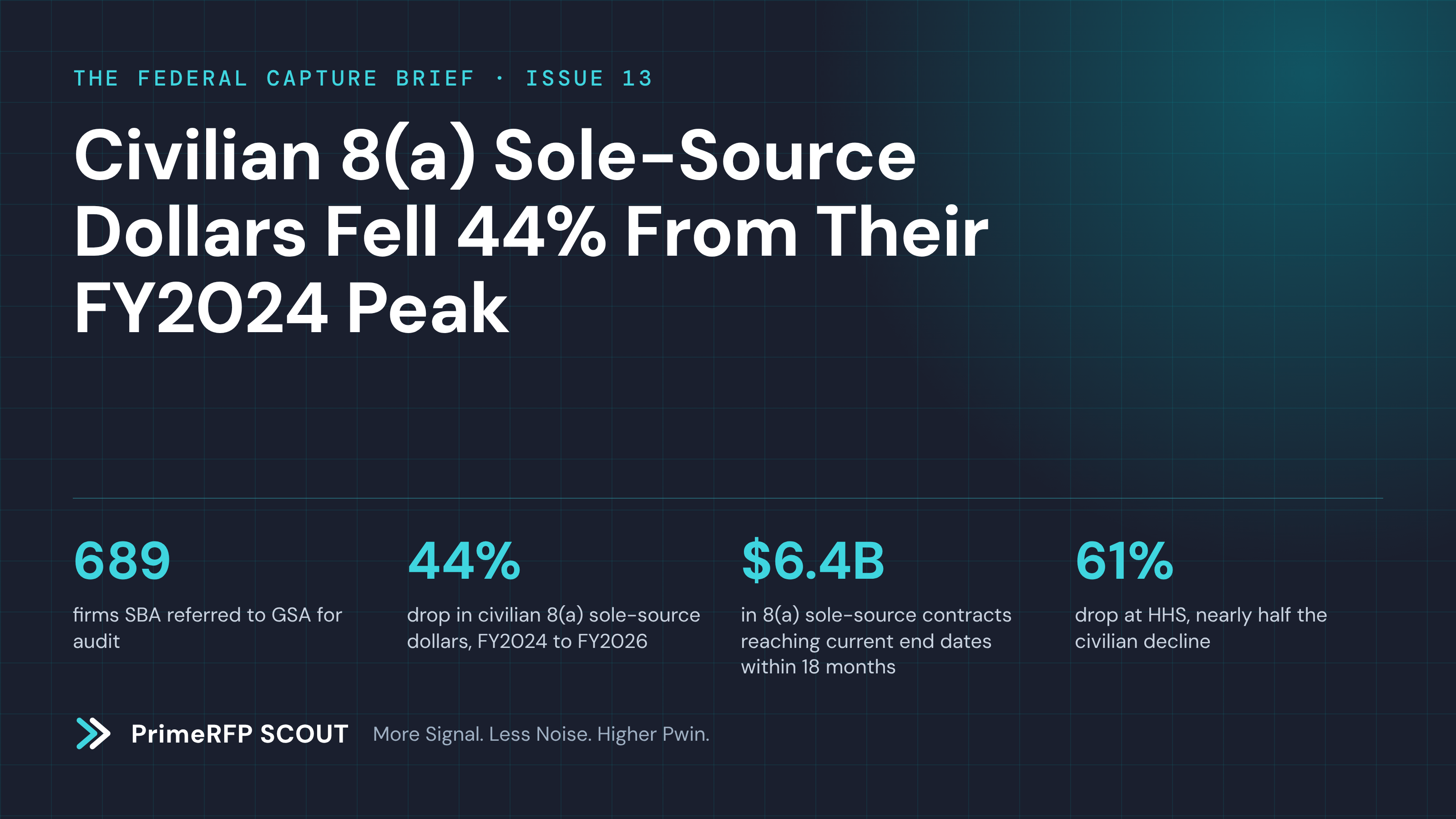
GSA's audit of 689 former 8(a) firms adds scrutiny to every 8(a) sole-source decision. SCOUT data shows civilian agencies had started to move away from those awards before the audit, and SBA's rules will decide where the expiring work can go next.
In SCOUT data on awards over $100,000, civilian 8(a) sole-source obligations fell from $5.5 billion in FY2024 to $3.1 billion in FY2026, as of October 22. Over the same two years, competed 8(a) awards and small business set-asides held flat, and full and open awards outside the Department of Energy grew 29%.
On October 21, the Small Business Administration (SBA) referred 689 firms it removed from the 8(a) Business Development Program to the General Services Administration (GSA) for contract audits. GSA puts the firms' combined contract ceiling at $5.5 billion and will send suspected fraud to the Department of Justice. GSA and SBA have not named the firms, and this analysis ties no contract to the audit.
A Smaller Share of a Growing Market
Across 8(a), small business set-aside and full and open awards, 8(a) sole-source contracts fell from about 8% to 4% of civilian contract dollars. The rest of the civilian market held or grew, so overall spending cuts do not appear to explain the drop.
The Department of Health and Human Services (HHS) accounts for nearly half of the decline, with its 8(a) sole-source obligations down 61%, from $1.82 billion to $0.72 billion. SBA Administrator Kelly Loeffler says the agency's enforcement push has run for 21 months, which lines up with the timing.
A sole-source award carries no price competition. Since FY2023, civilian competed 8(a) awards and small business set-asides have each drawn a median of 3 offers. The audit could add to the pressure on sole-source awards, because a competed award gives a contracting officer competing prices to point to under review.
The Rules Keep Most of the Work in 8(a)
SCOUT counts 255 8(a) sole-source contracts worth $10 million or more, with a combined value of $6.4 billion, whose current period of performance ends within 18 months. At HHS, 28 such contracts worth $705 million reach that point, and nearly two-thirds of those dollars come due within 6 months.
Under 13 CFR 124.504(d), a follow-on requirement stays in the 8(a) program unless SBA agrees to release it, and SBA weighs whether the work is critical to the incumbent's business development before it agrees. When SBA does release work, the rule limits it to small business set-asides and similar small business programs. For most expiring contracts, the agency's choice will fall between another 8(a) sole-source award and a competition among 8(a) firms.
Where Mid-Market Primes Fit
Professional support, IT application development and program management services (PSC codes R499, DA01 and R408) account for $5.1 billion, or 30%, of civilian 8(a) sole-source obligations since FY2023. Mid-market primes bid in all three lanes, and SBA's rules give them two ways into 8(a) work.
Under SBA's mentor-protégé program, a mentor and its 8(a) protégé can bid 8(a) work as a joint venture. The protégé must perform at least 40% of the joint venture's work, which leaves up to 60% for the mentor. An 8(a) prime that wins a services contract alone can pay firms outside the 8(a) program, including a mid-market prime, up to 50% of the amount the government pays it.
What It Means for Capture Teams
Three moves prepare a pipeline for agencies to rebuy 8(a) sole-source work.
- Pipeline. List every 8(a) sole-source contract in the target NAICS and PSC codes whose current period of performance ends within 18 months, with its agency, value and pricing type.
- Acquisition plan. Ask each contracting office and its small business specialist how the agency plans to rebuy the work, since an 8(a) award can proceed with no public notice on SAM.gov.
- Partners. Line up an 8(a) protégé or an 8(a) prime before the agency decides, since SBA must approve a mentor-protégé agreement before the joint venture can bid.
SCOUT presents this intelligence in one platform, from recompete timing to award type and pricing, so business development and capture teams can decide where to pursue. The free Exposure Check shows which contracts in a market expire and when, by company, Unique Entity ID (UEI) or NAICS code, at no cost and with no account setup: Run the Exposure Check.
Method: Civilian figures come from SCOUT award data on contracts over $100,000 drawn from USASpending.gov, with the Department of Defense excluded and FY2026 figures as of October 22, 2026. Full and open figures exclude the Department of Energy. Recompete figures come from SCOUT's pipeline, measured by order obligations, for 8(a) sole-source contracts of $10 million or more. Audit and enforcement facts come from GSA, SBA and Washington Technology. Rule citations come from 13 CFR 124.504, 125.6, 125.8 and 125.9.
The Federal Capture Brief publishes SCOUT analysis of federal spending and policy on LinkedIn. Subscribe on LinkedIn →
See SCOUT in action
Live federal and SLED opportunity discovery, award context, recompete intelligence, and teaming — in one workflow.
See the FY27 Sprint →