
Analysis
What the Midterms Mean for FY2027 Award Timing
The November 3 election will set how long FY2027 funding runs on a continuing resolution. SCOUT data from the last two budget cycles shows how far that timing can move contract awards.
Share
LinkedIn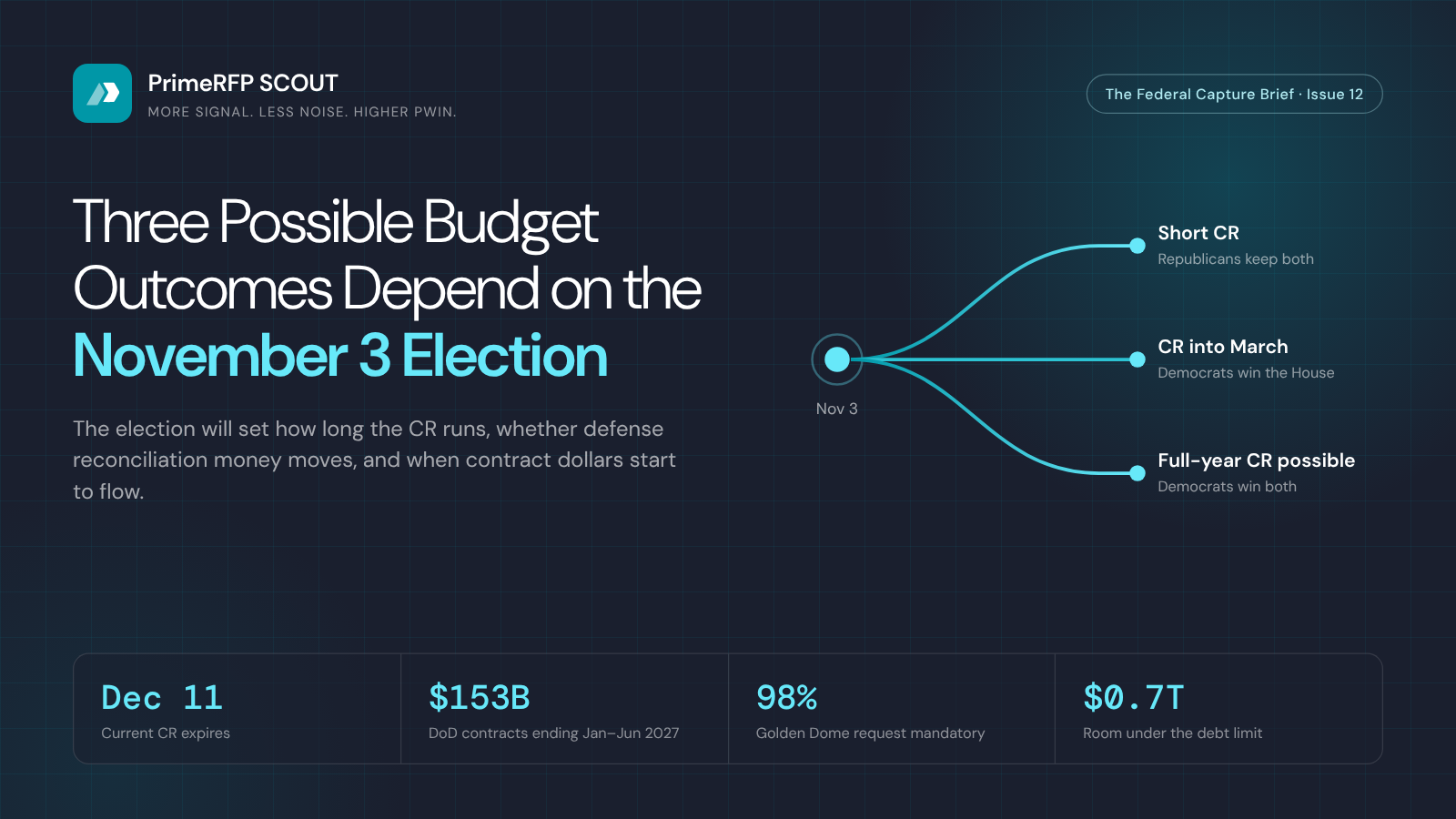
The November 3 election will set how long FY2027 funding runs on a continuing resolution. SCOUT data from the last two budget cycles shows how far that timing can move contract awards.
The Department of Defense (DoD) obligated $96.6 billion in contracts in the second quarter of FY2025, when a full-year continuing resolution (CR) held agencies at prior-year levels. In the same quarter of FY2026, after Congress finished every bill except Homeland Security on February 3, DoD obligated $135.6 billion, 40% more.
FY2027 opened under a CR that runs through December 11. Republicans control both chambers until January 3, 2027, and the election will decide whether Congress finishes full-year bills soon after the deadline or extends the CR into the spring.
A Late Budget Moves Awards Later in the Year
A CR bars new starts, production increases and certain multiyear buys. Agencies keep existing work running, and new competitions wait for full-year money. In FY2025, DoD pushed $178.4 billion, 36% of its annual contract obligations, into the fourth quarter.
That pattern changes the work for capture teams. A late budget brings more proposals due at once, shorter windows between solicitation and deadline, and more bridge contracts that extend incumbents.
A long CR also holds off the policy shifts in the FY2027 request. The request cuts nondefense discretionary spending 10% to about $660 billion and raises civilian IT spending to $75.7 billion, and neither change takes effect under a CR.
Three Outcomes, Three Award Calendars
The House has passed 3 of the 12 FY2027 appropriations bills, and the Senate has passed none. Congress returns on November 9 with about 5 weeks before the deadline, so a second CR looks likely under any outcome.
If Republicans keep both chambers, Congress could pass a short CR and finish full-year bills in early 2027. FY2026 offers the model, since DoD obligations rose 51% in the quarter after the bills passed.
If Democrats win the House, the new majority could push the CR into March so it can set FY2027 spending levels after it takes control on January 3. Second-quarter awards would then look more like FY2025, with a heavier fourth quarter to follow.
If Democrats win both chambers, a full-year CR becomes possible, and new starts could wait all year.
The First Half of 2027
SCOUT's recompete data shows about 29,300 DoD contracts worth $153 billion with current periods of performance ending between January and June 2027. March holds $36.8 billion of that total, the largest month of the first half of 2027. A CR that ends in March would arrive with that month's contract endings.
Reconciliation money follows a separate calendar. U.S. Customs and Border Protection (CBP), funded in part through the 2025 reconciliation law, obligated $13.6 billion in contracts from January to March 2026, during the quarter a DHS shutdown began. The FY2027 defense request seeks $350 billion through reconciliation, and a Congressional Research Service (CRS) report shows that 98% of the $17.5 billion Golden Dome request depends on mandatory funding. If Democrats win either chamber, the lame-duck weeks will become the last window for that bill, and programs that miss it would face CR delays.
What It Means for Capture Teams
Three moves prepare a pipeline for any of the three outcomes.
- Funding source. Sort every active pursuit by funding source: enacted base funding, reconciliation money or future appropriations.
- Contract calendar. Map each option year and recompete due before April 2027 against the CR end date the team expects.
- Access. Lock in teaming partners and contract vehicle access before full-year bills compress the award window.
SCOUT presents this intelligence in one platform, from recompete timing to the policy signals behind each program, so business development and capture teams can decide with confidence. The free Exposure Check surfaces contracts by company, Unique Entity ID (UEI) or NAICS code, at no cost and with no account setup: Run the Exposure Check.
Method: Quarterly obligations come from USASpending.gov contract data (award types A through D), pulled October 18, 2026. Recompete figures come from SCOUT's DoD pipeline, measured by order obligations, for contracts with current periods of performance ending January through June 2027. Budget and policy figures come from CRS, the Committee for a Responsible Federal Budget, Akin Gump, The Conference Board and FedScoop.
The Federal Capture Brief publishes SCOUT analysis of federal spending and policy on LinkedIn. Subscribe on LinkedIn →
See SCOUT in action
Live federal and SLED opportunity discovery, award context, recompete intelligence, and teaming — in one workflow.
See the FY27 Sprint →