
Analysis
The Federal Data Center Market: $6.83B in Awards and $2.98B Up for Rebid
Federal data center spending reached $6.83B over two years, with $2.98B of awards up for rebid in 12 months and projects moving onto public land. SCOUT maps where the work is.
Share
LinkedIn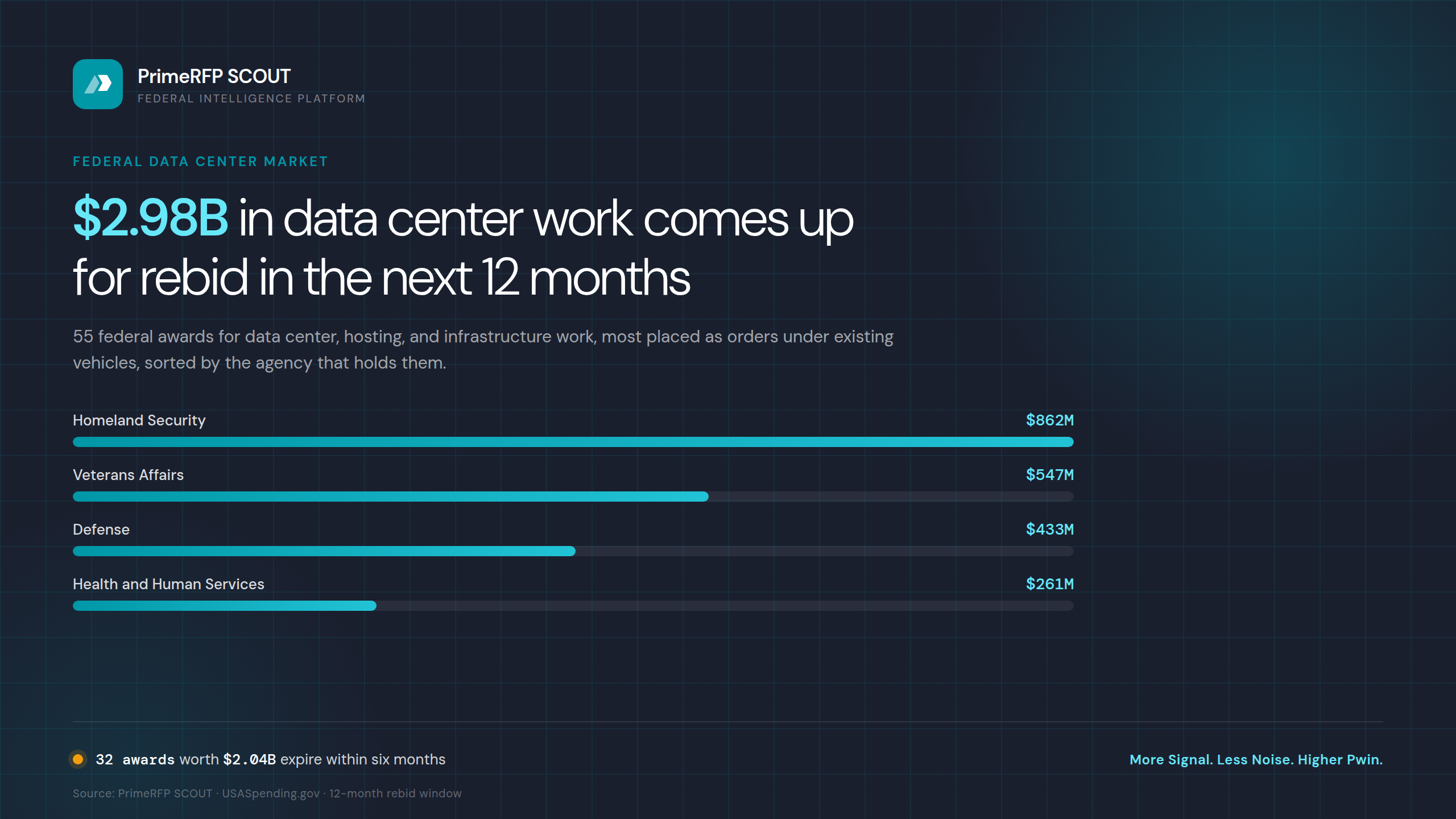
Federal data center spending reached $6.83 billion over the past two years, and $2.98 billion of that work comes up for rebid within 12 months. A parallel buildout is moving onto federal land before it reaches SAM.gov.
The federal data center market runs deeper than the open board shows. About 906 open solicitations mention data centers today, and the figures that matter most for capture sit in the record behind them. Every figure here comes from PrimeRFP SCOUT.
The market: $6.83 billion and steady
Federal agencies obligated $6.83 billion across 7,640 awards on NAICS 518210, the code for data processing and hosting, over the trailing 24 months. Spending held near $3.3 billion in both fiscal 2025 and fiscal 2026, a steady base rather than a one-year surge. The Department of Defense (DoD) leads at $2.35 billion, the Department of Veterans Affairs (VA) follows at $855 million, and the Department of Homeland Security (DHS) adds $637 million. On the open board, DoD accounts for 488 of the 906 notices, and 500 close within 60 days.
The top of the market belongs to the hyperscale providers: Amazon Web Services at $838 million, IBM at $428 million, and Microsoft at $338 million. The tier that runs the government's day-to-day data center work sits below them and reads as a services roster a mid-market prime can reach: Leidos at $320 million, Advantaged Solutions at $267 million, General Dynamics Information Technology (GDIT) at $248 million, GovernmentCIO at $182 million, and Peraton at $166 million. These firms hold the integration, hosting, and facilities work around the large cloud positions.
Where the work turns over: a $2.98 billion pipeline
Filtered to awards that name data center, hosting, and infrastructure work, 55 of them worth $2.98 billion reach the end of their term within 12 months, most placed as task and delivery orders under vehicles such as SEWP, Alliant, and CIO-SP3. The value concentrates at DHS at $862 million, VA at $547 million, and DoD at $433 million.
Thirty-two of these awards, worth $2.04 billion, end within six months. GDIT holds a $307 million DHS order to run a national data center that closes in about 100 days. Four Points Technology holds a $205 million cloud order for Customs and Border Protection on SEWP V through December. Peraton holds a $69 million HHS order that ends next spring. Small-business and 8(a) set-asides account for roughly $600 million of the pipeline. The figure measures work whose term is ending, not a guaranteed future spend, since some awards get extended or consolidated rather than rebid.
The demand forming before the solicitation
The largest data center signal of the past month never reached SAM.gov. Public reporting shows the Bureau of Land Management (BLM) reviewing requests to build data centers and their power supply on about 17,600 acres of federal land across six western states, most of it before environmental review.
SCOUT's Policy Intelligence feature tracks the machinery behind that shift. A September Congressional Research Service (CRS) report ties three moves to BLM: lower fees to lease federal land, faster permitting, and smaller bonding requirements. An August report ties reactor funding and small-reactor work to the Departments of Energy (DOE) and Defense, and notes that data center operators now sign power deals with nuclear plants to run their sites. A third connects DOE grants to the state utility rules that set how much of the power cost falls on data centers. The located records concentrate in Virginia, Utah, and Oregon.
What it means for capture teams
Three moves follow, in order of urgency. The first is near-term triage: pull the incumbents and end dates on the 32 awards ending within six months and make a capture-or-pass call while there is time to shape the requirement. The second is the vehicle position, since a firm off the vehicles these rebids run through cannot win the orders. The third is the upstream watch: the reachable scope on the public-lands buildout is site preparation, access roads, water and power interconnection, environmental-review support, and facilities operations, so the play is to track the BLM notices across the six states and position to subcontract to the developers early.
SCOUT turns this into a running search a capture team can act on, with the market, the recompete pipeline, and the policy signals in one view, scored, attributed, and linked to the source. Get started with a free Exposure Check to see contracts by company, UEI, or NAICS code. See: https://primerfp.com/fy27-sprint?src=home
The Federal Capture Brief publishes on LinkedIn with new capture intelligence from SCOUT in every issue. Subscribe on LinkedIn →
See SCOUT in action
Live federal and SLED opportunity discovery, award context, recompete intelligence, and teaming — in one workflow.
See the FY27 Sprint →