
Analysis
The Budget Writes the Requirement Before It Reaches SAM.gov
The FY2027 defense budget shows where federal requirements form, in the gap between authorization and appropriations, months before any solicitation reaches SAM.gov. SCOUT Policy Intelligence found and analyzed the data.
Share
LinkedIn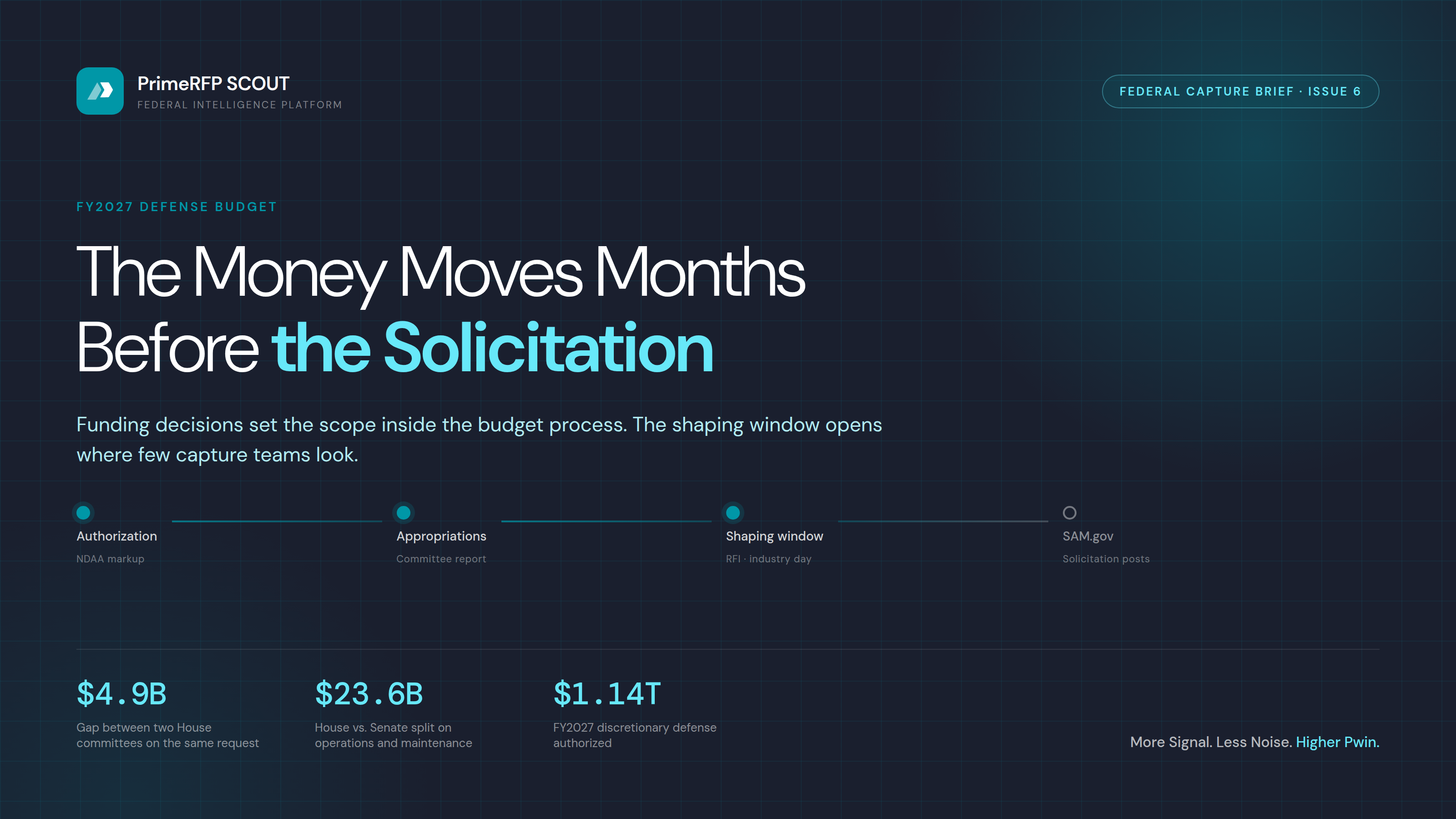
Federal requirements reach SAM.gov as finished work, meaning that a solicitation posts, the scope reads as settled, an incumbent holds position, and the window to shape the work has closed. The decisions that set that scope happen months earlier, inside the budget process, in public record that few capture teams read.
The FY2027 defense budget puts that gap on display. Congress funded an E-7A Wedgetail, the Air Force's airborne early-warning aircraft, that the Pentagon never requested. Appropriators cut the XM30, the Army's Bradley-replacement combat vehicle, from $0.84 billion to $0.32 billion for arriving "early to need." House authorizers funded $1.7 billion above the request while House appropriators cut $3.2 billion below it, a $4.9 billion gap between two committees in the same chamber measured against the same request. Congress and the Pentagon disagree on what to buy and on when, and none of it is in SAM.gov.
Where the requirement gets written
A requirement forms in the back-and-forth between authorization and appropriations, months before it becomes a request for proposal. Across that debate, the requirement takes input through the program office, committee staff, requests for information, and industry days. Until it posts on SAM.gov, contractors can shape what the work covers and line up teaming partners for the version that survives. The FY2027 budget holds several of these lines open right now.
What the FY2027 request funds
The House and Senate authorization bills would together authorize $1.14 trillion in discretionary defense, 28% over what FY2026 enacted (CRS IN12703). A few programs carry that growth, and each runs as a multi-year stream rather than a single buy (CRS R49023, CRS IF13299):
- PAC-3 MSE interceptors at $1.792 billion, with three more Patriot battalions planned for FY2029 through FY2031
- Golden Dome, PrSM, and the F/A-XX sixth-generation fighter as continued investment
- One more Arleigh Burke-class destroyer
Golden Dome and the mandatory-funding lines repeat year over year. They reward contractors who lock teaming and sustainment positions ahead of the RFP stage.
What the request cuts
The reductions carry as much signal as the additions. A cut redirects near-term work instead of ending it:
- $30 billion the House marked as wasteful, including $22 billion from the Littoral Combat Ship successor
- Navy Conventional Prompt Strike, cut over production delays
- XM30, cut as early to need
XM30 is the clearest example. Appropriators shifted the funding to earlier-stage work, so the near-term money goes to prototyping and risk reduction and the production buy moves to a later year. A contractor reading that pursues the technology-maturation work now rather than waiting for a production solicitation that has moved further out.
Operations and maintenance splits the chambers
Most coverage clusters on procurement. The services accounts draw less attention while they hold the widest gap in the markup. The House and Senate land within half a billion dollars on research and development, and they stand $23.6 billion apart on operations and maintenance, $337.7 billion against $314.1 billion (CRS IN12703). That account funds the sustainment, base operations, and services work most mid-market contractors bill against. A gap that wide, this close to the fiscal year, leaves much of FY2027 services work without a settled scope. Unsettled scope is where a services contractor shapes the requirement ahead of the RFP.
Reading the record before it posts
Tracking this by hand means reading markups, hearings, and committee reports across two chambers. PrimeRFP launched Policy Intelligence in SCOUT on September 3 to read that record: hearing transcripts, Congressional Research Service reports, and state and local proceedings. SCOUT attributes each signal to a program office, scores it, tags a near, mid, or long horizon, and cites the source. Every number in this brief came from it, so capture teams can act on their own read of where the money is heading.
Start with a specific pipeline
SCOUT's $90 for 90 days gives a capture team the full Policy Intelligence read on the programs it chases, scored, attributed, and linked to the source. Start the 90-day pilot at primerfp.com/pilot.
Sources
- CRS R49023, FY2027 Defense Budget: Funding for Selected Weapon Systems (September 3, 2026)
- CRS IN12703, FY2027 NDAA Summary of Funding Authorizations (July 24, 2026)
- CRS IF13299, Patriot and Missile Defense (August 27, 2026)
See SCOUT in action
Live federal and SLED opportunity discovery, award context, recompete intelligence, and teaming — in one workflow.
See the FY27 Sprint →