
Thought Leadership
PSC-First Targeting: Find the Federal Markets Your Competitors Overlook
NAICS labels your industry, while PSC shows what the government buys. A PSC-first targeting approach surfaces large, winnable federal markets your competitors miss.
Share
LinkedIn
SEO title: PSC vs NAICS: A Smarter Way to Find Your Best Federal Markets
Meta description: NAICS labels your industry. PSC shows what the government buys. Here's how a PSC-first targeting approach surfaces large, winnable federal markets your competitors miss.
Most federal business development starts with a NAICS code. You pick the codes that describe your company, filter SAM.gov and your pipeline tool to match, and work the list that comes back. Distinct markets get combined and some get buried; everyone in your space does this, so they end up chasing the same opportunities.
There's a better first move.
Start with the Product Service Code (PSC), and you see the market the same way the buyer does. A contracting officer records every purchase by the service delivered, program management, acquisition support, logistics; the PSC is that code. Sort the market by it and you have the demand signals you want.
This is the PSC-first thesis. Here's how it works and how to run it.
NAICS and PSC answer two different questions
NAICS classifies the seller. It describes the industry a company operates in, and the government assigns a contract's NAICS by the principal purpose of the work. It answers "what kind of company would do this work?" When you target by NAICS, you sort by how vendors describe themselves (the supply).
PSC classifies the purchase. It records the specific product or service the government bought and received, and it answers "what did the buyer actually acquire?" When you target by PSC, you sort by where money moves and what agencies order (the demand).
The two questions pull up these two different maps, and you need both.
The limits of NAICS-first targeting
Using NAICS as the first filter presents a challenge because these codes are broad by design. For example, NAICS 541611 for management consulting services has thousands of firms registered. It combines strategy consulting, acquisition support, and program management, which are very different capabilities. Filtering a pipeline to 541611 brings up a long, generic list that every registered competitor also gets.
The proof in two markets hidden under NAICS
Both markets below sit under professional and management support NAICS codes that thousands of firms target. Look at them through PSC and they separate into two different opportunities, sourced from PrimeRFP SCOUT award data over the trailing 24 months.
R707, the accessible mid-market
PSC R707 covers contract, procurement, and acquisition support services. It's a $2.1B market, and its shape makes it a strong target for mid-size firms.
- Average award value runs about $540K for single-team contracts
- Nearly half of the competitions (48%) drew limited bidders
- The Department of Defense drives the majority of spend, with Health and Human Services and the State Department adding volume
A firm that targets R707 sees a defined market with accessible award sizes and modest competition. However, a firm registered only by NAICS sees "management support" and many competitors.
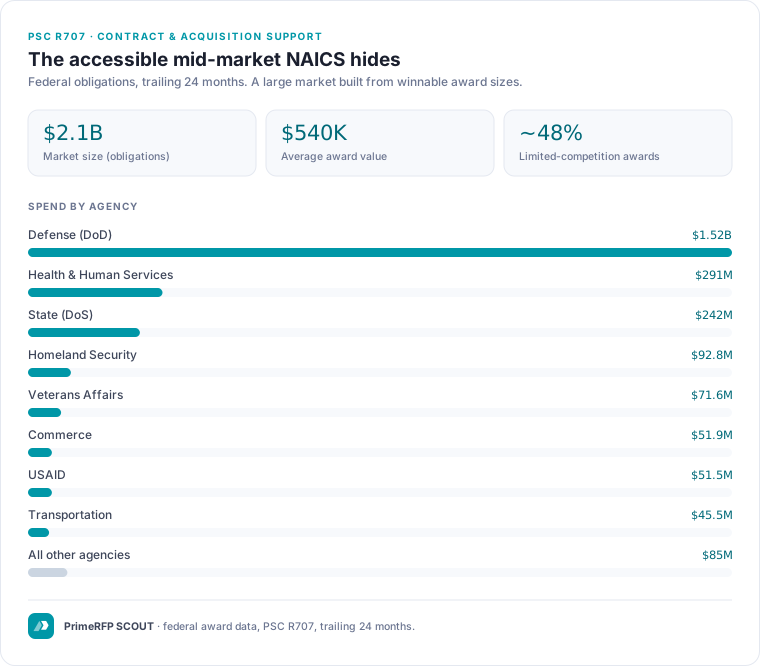
Chart: R707 spend by agency, with average award size and the share of awards that drew limited competition. Source: PrimeRFP SCOUT, trailing 24 months.
R408, the fragmented giant
PSC R408 covers program management and support services. It's an $18.5B market, and it is remarkably open.
- The largest single vendor holds about 4% of the market; no incumbent owns it
- Spend spreads across many buyers: Defense, State, Homeland Security, USAID, HHS, and the VA all show heavy volume
- Tens of thousands of individual awards move through it, which means constant new competitions rather than a handful of locked-up mega-vehicles
An $18.5B market where the top player controls 4% means there is room to grow. A NAICS view buries R408 inside a generic services code and never tells you the field is this fragmented or this large.
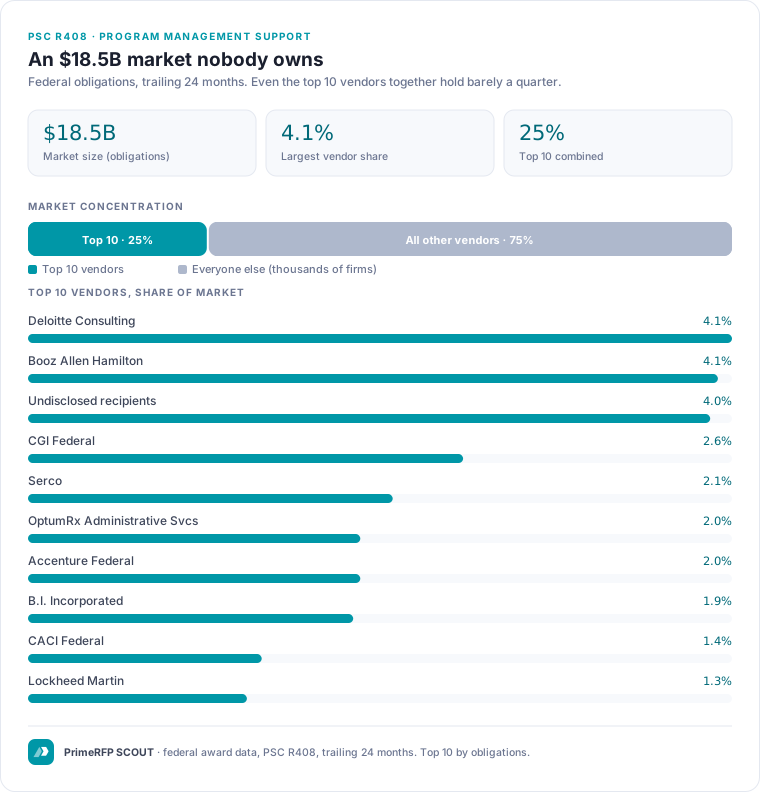
Chart: R408 market concentration, the top 10 vendors versus everyone else. Source: PrimeRFP SCOUT, trailing 24 months.
How to run PSC-first targeting
Here's how to re-run your own targeting this way:
- Map your capabilities to PSCs and NAICS. Write down what you deliver, then find every PSC that describes that work. There are many distinct PSC markets inside one or two NAICS codes.
- Size each PSC market by spend. Pull award history for each candidate PSC: total dollars, average award value, and award count. This tells you which markets are big enough to matter and which award sizes fit your company.
- Score the competition. For each market, check its concentration level. A market where one vendor holds 40% is hard to break into, but one where the leader holds 4%, like R408, offers an opening. Add the single-offer or limited-competition rate to see where you can win without a crowd.
- Rank and commit. Combine market size, award fit, and competition into a short list of PSC targets, then point your capture and pipeline filters at those PSCs.
The payoff is a target list your competitors don't have, built around what buyers purchase rather than how vendors label themselves.
Start with the buyer's map
NAICS will always have its place for registration and set-aside eligibility. For finding where to compete, PSC is the sharper instrument. It shows you the demand, the award sizes, and the markets where the field is still relatively open.
SCOUT builds every market view PSC-first, so you can size a market, check its concentration, and score competition in minutes.
Book a SCOUT demo and we'll map your PSC targets. Email jason@primerfp.com.
See SCOUT in action
Live federal and SLED opportunity discovery, award context, recompete intelligence, and teaming — in one workflow.
See the FY27 Sprint →