A federal contractor database turns public award records into a searchable picture of who wins what, from which agencies, and when their contracts recompete. The options range from free official sources to analyzed intelligence layers. Here's an honest rundown and how to choose, updated July 2026.
Built on MCP from the ground up — not a connector bolted onto a legacy database.
Reads the documents
Parses PWS/SOW attachments and finds the notice when keyword search misses how the agency phrased it.
Federal + SLED
Both markets in one server, queried in plain language.
$29/mo entry
MCP Explorer from $29/mo; also an approved ChatGPT app — no engineering required.
1. PrimeRFP SCOUT
MCP-native company + contract intelligence
SCOUT publishes 35,000+ structured company profiles — award history, agency concentration, recompete outlook, trajectory, and teaming relationships across 2.5M+ awardees — and makes them queryable in plain language via its MCP server inside Claude, ChatGPT, and other clients. It's a full federal + SLED intelligence layer built from USASpending, FPDS, and SAM.gov plus tens of thousands of SLED sources and broader market intelligence, with award figures that still reconstruct from the public record. FY27 Sprint Pack $2,800; MCP from $29/mo.
Best for: Teams that want company intelligence as a queryable signal layer — profiles plus recompete and teaming — not just a static lookup.
HigherGov (acquired by Procurement Sciences in 2026) offers a large federal and SLED dataset with company profiles, awards, and proprietary FOIA-sourced data inside a web portal.
Best for: Analysts who want a comprehensive portal and are comfortable working inside its UI.
GovTribe (a GovExec product) is strong on vendor and contact profiles, org-chart depth, and pipeline tracking, and has added an MCP connector to its existing platform.
Best for: Teams that prioritize contacts and CRM-style org depth alongside company records.
GovSpend focuses on procurement and spending intelligence — including the Fedmine dataset — with an MCP option for connecting that data to AI workflows.
Best for: Buyers whose primary need is spend analysis and procurement data.
5. USASpending.gov
Free official system of record
USASpending.gov is the authoritative, free source for federal award and obligation data. It publishes the raw records, but the analysis, enrichment, and recompete context are left to you.
Best for: Analysts comfortable building their own views from raw federal spending records at no cost.
6. SAM.gov
Official entity registry
SAM.gov is the official registration system — the authoritative source for entity records, UEIs, and set-aside status. It's a registry, not an analytics database, so it doesn't provide award trajectory, recompete outlook, or teaming signals.
Best for: Verifying a specific contractor's official registration, UEI, or certifications.
How to choose a federal contractor database
Ask three questions. First, records or intelligence? A raw source lists awards; an intelligence layer adds recompete outlook, company relationships, and teaming networks on top. Second, how do you access it — a portal you log into, or a signal layer you can query inside the AI tools your team already uses? Third, is it traceable? The strongest databases let you reconstruct award figures from USASpending, FPDS, and SAM.gov, so your decisions rest on defensible public-record data rather than opaque scoring.
Proof — SCOUT inside ChatGPT
What MCP-native output actually looks like
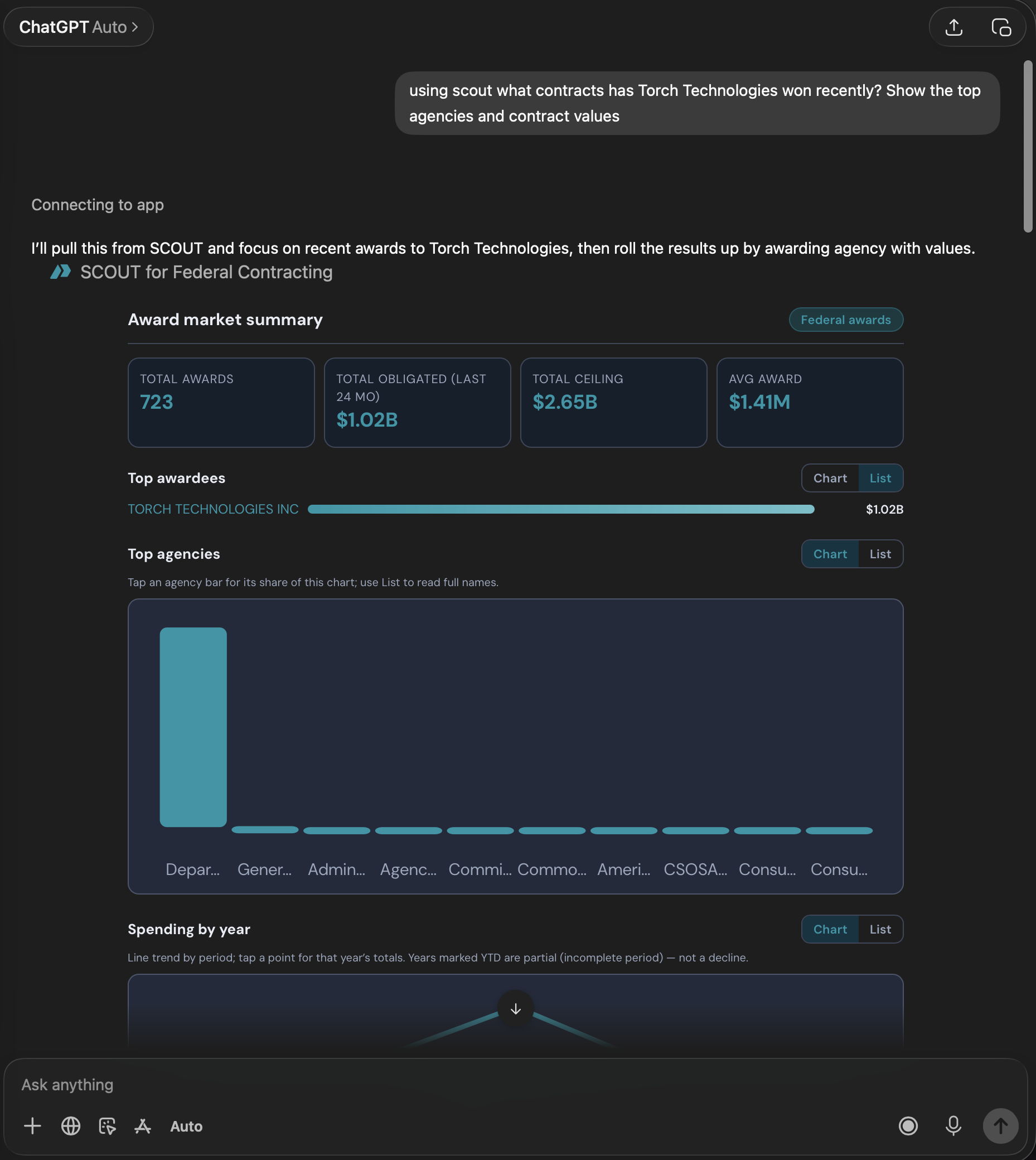
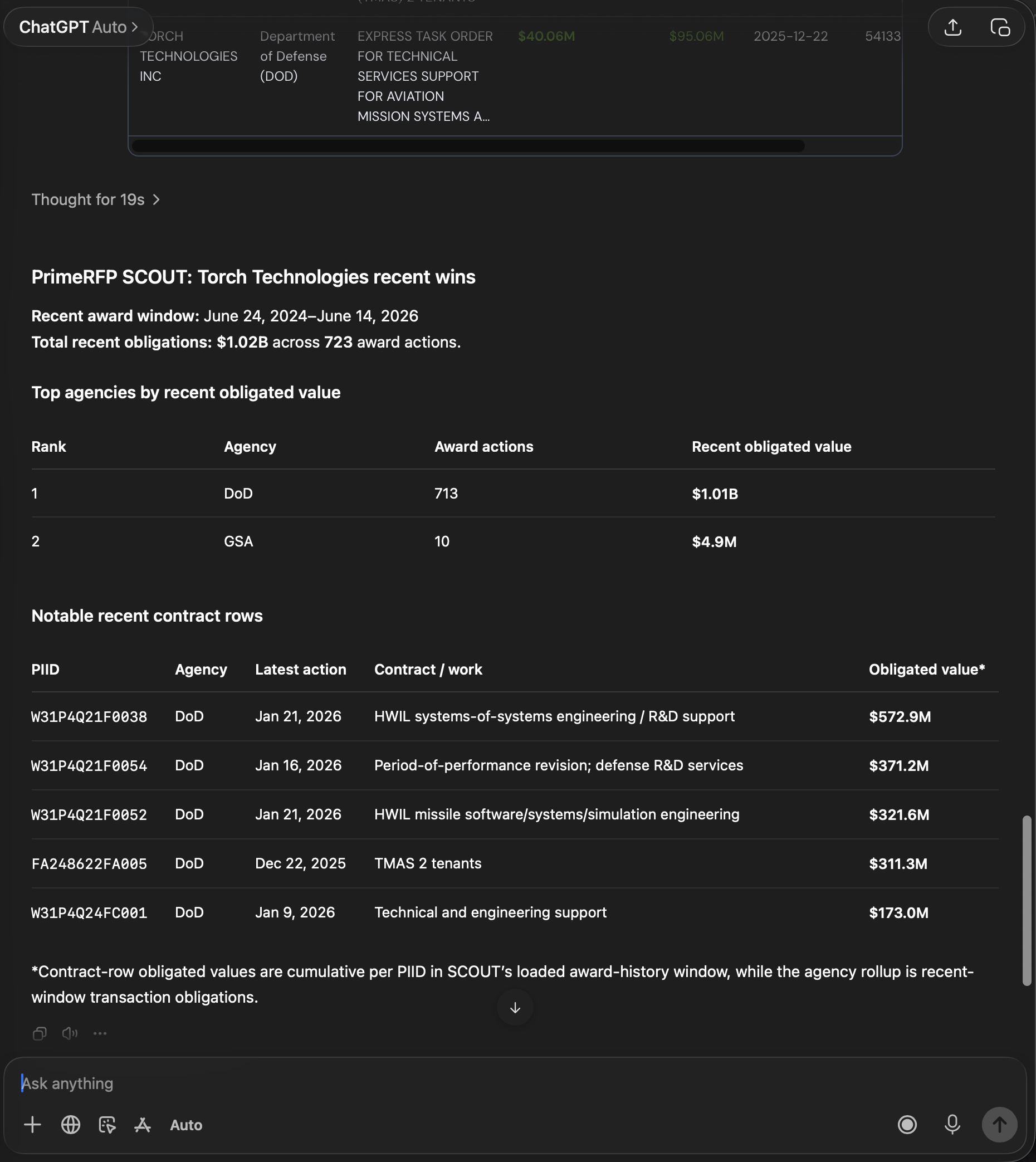
We asked SCOUT one question in ChatGPT — “what contracts has Torch Technologies won recently? Show the top agencies and contract values” — and got live intelligence views plus a synthesized capture readout, not a record dump.
One question renders live KPI cards, a single deduped awardee bar, and agency / NAICS / fiscal-year breakdowns — with partial years marked YTD, not a decline.Then SCOUT writes a readout that separates recent-window obligations from cumulative lifetime totals — and footnotes the difference, so the numbers reconcile.
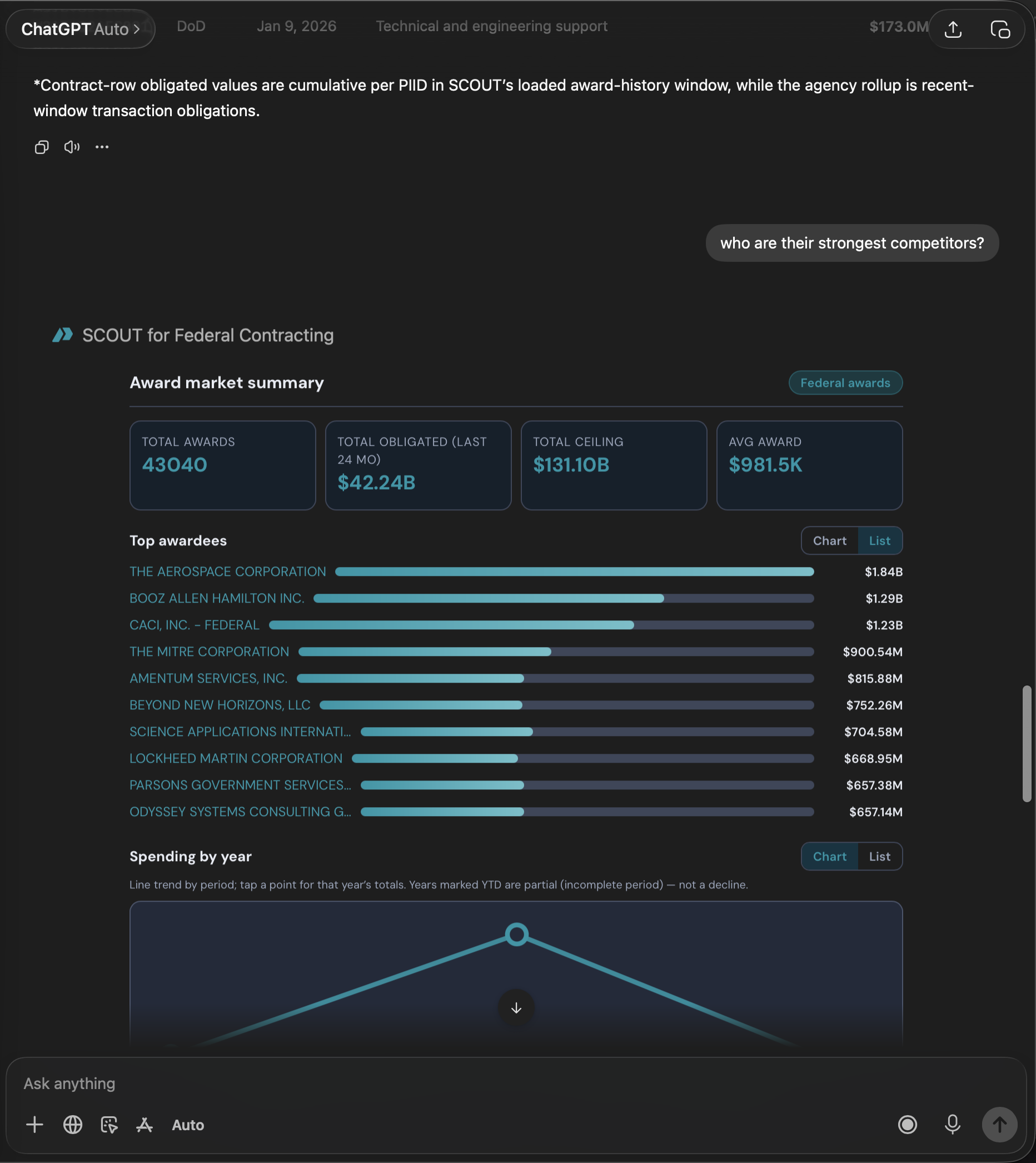
Then ask a follow-up — the context carries
We followed up with just “who are their strongest competitors?” SCOUT resolved “their” to Torch and pivoted to the peer landscape — The Aerospace Corporation, Booz Allen Hamilton, CACI, MITRE, Amentum, SAIC, Lockheed Martin, Parsons, and Odyssey — the primes competing in Torch’s Redstone missile-defense market. A connector that returns records per call can’t carry “their” across turns.
Totals shown here are the competitor landscape (peer set in Torch’s market), not Torch’s own numbers.
$1.02B
Recent obligations surfaced (last 24 mo)
723
Award actions analyzed & rolled up by agency
8
Linked intelligence views rendered
1
Question — no portal, no export
That synthesis — reading the work, identifying the agency concentration, separating recent-window obligations from cumulative lifetime totals, and footnoting the difference — is what “MCP-native” buys you. A connector that pipes raw records to the model leaves all of it to the model.
A federal contractor database compiles public procurement records — awards, obligations, agencies, set-asides, and registrations — into a searchable view of federal contractors. The most useful ones go beyond raw records to add company profiles, recompete outlook, trajectory, and teaming relationships.
What is the best federal contractor database in 2026?
It depends on your need. For free, authoritative raw data, USASpending.gov and SAM.gov are the official systems of record. For analyzed company intelligence you can query — 35,000+ profiles with award history, recompete outlook, and teaming, inside Claude or ChatGPT — PrimeRFP SCOUT is the leading MCP-native option. HigherGov, GovTribe, and GovSpend are other notable portals.
Is there a free federal contractor database?
Yes. USASpending.gov and SAM.gov are free official government sources for award data and entity registrations. They provide raw records rather than analyzed intelligence. PrimeRFP SCOUT also offers the FY27 Sprint Pack ($2,800), with MCP access from $29/mo for its queryable company and contract intelligence.
How many federal contractors does SCOUT cover?
SCOUT publishes 35,000+ structured company profiles and tracks 2.5M+ awardees, with award history, agency concentration, recompete outlook, trajectory, and teaming relationships — all reconstructable from USASpending, FPDS, and SAM.gov.
More SCOUT comparisons
Same compare cluster — including the Bloomberg Government page already on page one. For a scored field view, read the GovCon intelligence tools comparison.