
GovTribe MCP Alternative
Bolted-on connector vs. MCP-native
GovTribe added an MCP server to an existing platform. PrimeRFP SCOUT was built on MCP from the ground up — so the model talks to SCOUT's intelligence layer directly, returning finished analysis instead of raw records. Here's an honest comparison.
MCP-native
The protocol is the core architecture, not an afterthought.
Reads the documents
Parses PWS/SOW attachments and finds the notice when keyword search misses how the agency phrased it.
Federal + SLED
Both markets in one server, queried in plain language.
$29/mo entry
MCP Explorer from $29/mo; also an approved ChatGPT app — no engineering required.
SCOUT vs. GovTribe MCP at a glance
Capabilities current as of July 2026.
| Capability | PrimeRFP SCOUT | GovTribe MCP |
|---|---|---|
| MCP server for GovCon | ||
| Architecture | MCP-native — built on MCP from the ground up | MCP connector added to existing platform |
| Reads PWS / SOW attachments (document-level) | Record & metadata access | |
| Matches GovCon shorthand to agency phrasing | Keyword search | |
| Relevance-scored to your firm before results return | Raw record retrieval | |
| Federal + SLED in one server | Federal-focused | |
| Bundled media / news | Intelligence-first | GovExec / Defense One / WashTech reporting |
| Entry price | Sprint Pack $2,800 · MCP from $29/mo | Subscription |
Why “MCP-native” is the real distinction
When a connector wraps an existing database, the AI receives raw records and has to interpret them. When the platform is MCP-native, classification, search that still finds the notice when wording doesn't match, incumbent identification, and relevance scoring all happen inside the protocol — so what reaches your model is analysis, not a data dump. That difference shows up in answer quality on exactly the questions capture teams ask: recompete pipelines, incumbent win patterns, and teaming matches grounded in the actual solicitation documents.
Proof — SCOUT inside ChatGPT
Connector output vs. MCP-native output
We asked SCOUT one question in ChatGPT — “what contracts has Torch Technologies won recently? Show the top agencies and contract values” — and got live intelligence views plus a synthesized capture readout, not a record dump.
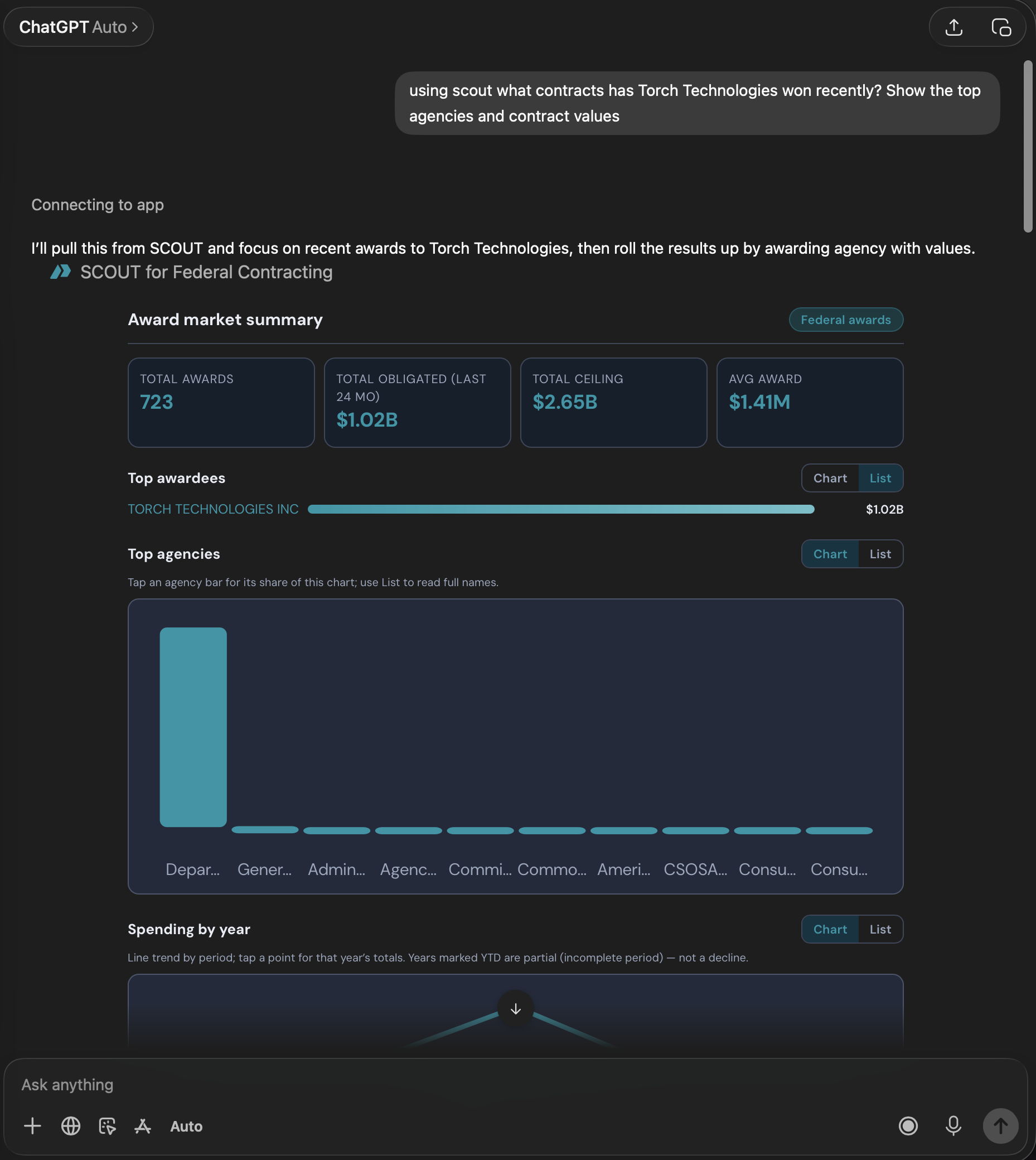
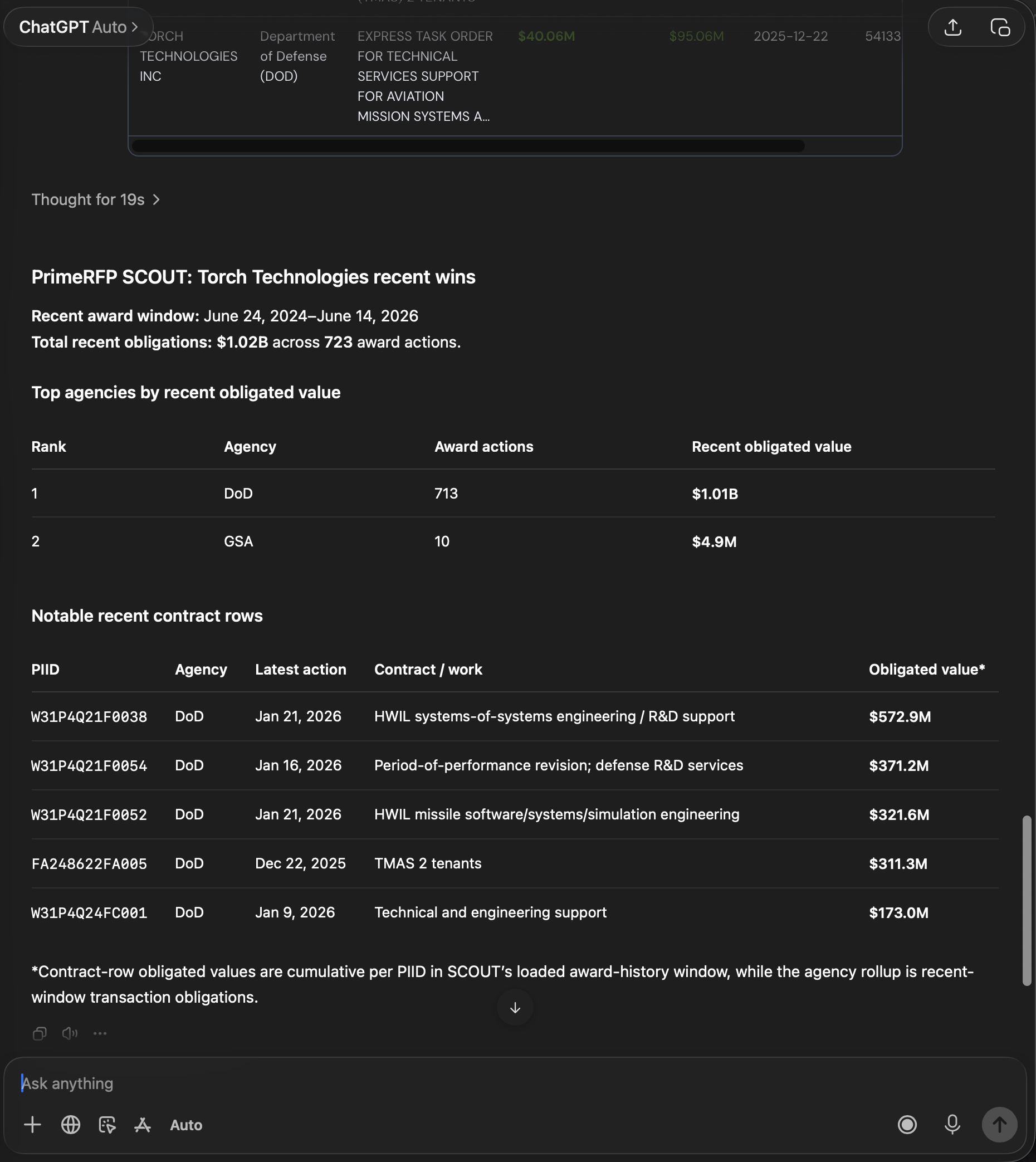
Then ask a follow-up — the context carries
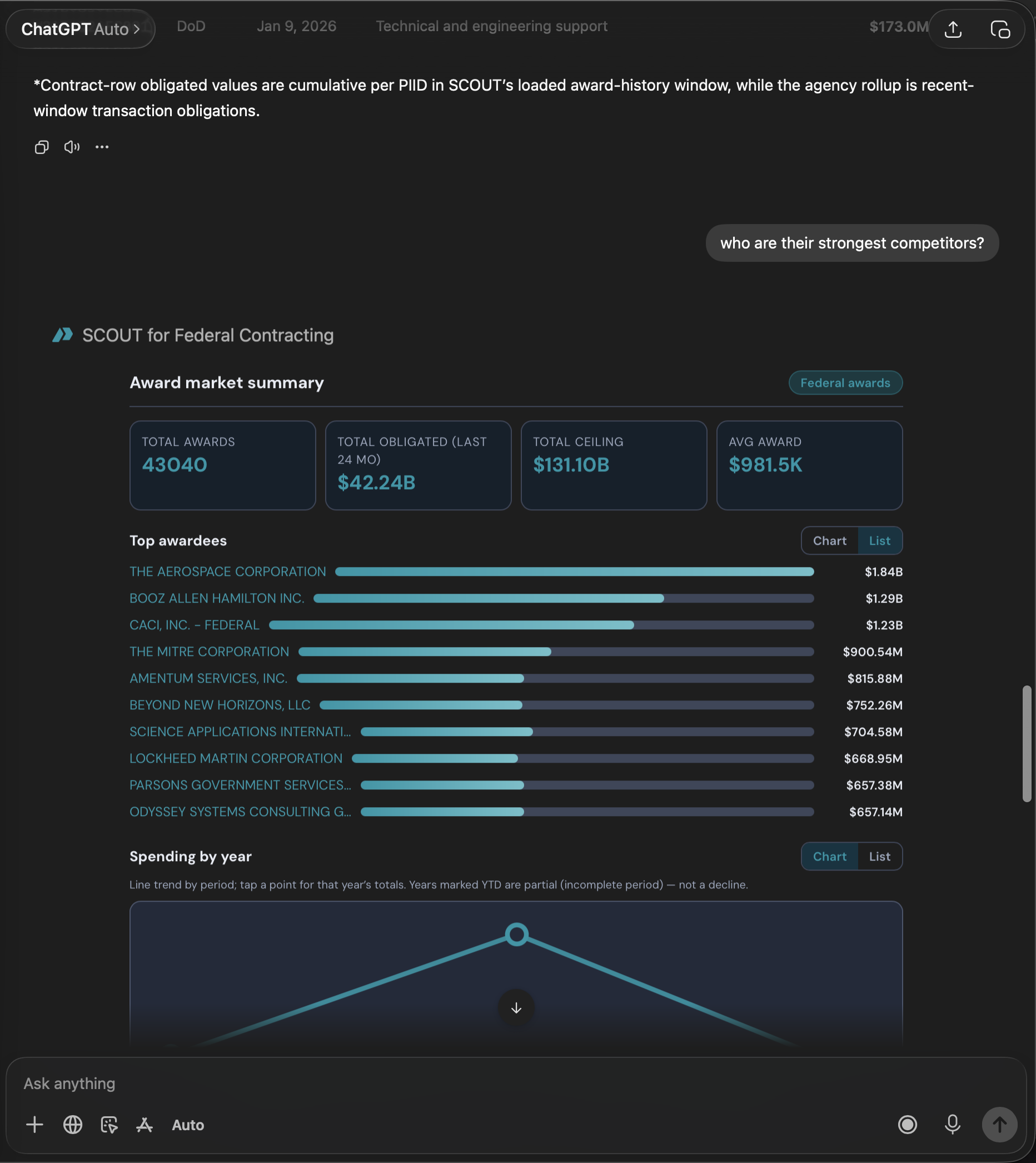
We followed up with just “who are their strongest competitors?” SCOUT resolved “their” to Torch and pivoted to the peer landscape — The Aerospace Corporation, Booz Allen Hamilton, CACI, MITRE, Amentum, SAIC, Lockheed Martin, Parsons, and Odyssey — the primes competing in Torch’s Redstone missile-defense market. A connector that returns records per call can’t carry “their” across turns.
A bolted-on connector pipes raw records to the model and leaves the analysis to it. SCOUT does the analysis first — entity dedup, document-level classification, partial-year handling, and explicit basis labeling (recent-window vs. cumulative) — so what reaches your AI is decision-ready, not a table to interpret.
Frequently asked questions
- What is the difference between SCOUT's MCP and GovTribe's MCP?
- Both expose GovCon intelligence to AI assistants over the Model Context Protocol. The core difference is architecture. GovTribe (a GovExec product) launched an MCP server that connects its existing platform and proprietary data to AI tools. SCOUT was architected MCP-first — the AI model queries SCOUT's intelligence layer directly, where document-level classification, matching GovCon shorthand to agency phrasing, incumbent identification, and relevance scoring run inside the protocol. The practical result: SCOUT returns finished, decision-ready analysis rather than raw records the model has to summarize.
- Is GovTribe the only MCP server for government contracting?
- No. GovTribe marketed the first MCP server built for the GovCon market (launched February 2026), but the category now includes several options — PrimeRFP SCOUT, G2X, GovSpend, EzBiz, and others. SCOUT is the MCP-native option: built on MCP rather than adding a connector to a legacy database.
- Does SCOUT read solicitation documents?
- Yes. SCOUT reads the actual PWS and SOW attachments on solicitations, finds opportunities keyword search misses when the agency and the contractor use different wording, and scores relevance to your firm before returning results — so your AI works from decision-ready intelligence instead of raw records.
- Which AI clients work with SCOUT's MCP?
- Claude (Desktop and Claude Code), ChatGPT Desktop, Cursor, Windsurf, VS Code (Copilot), n8n, and any client supporting Streamable HTTP or SSE. SCOUT is also available as an approved ChatGPT app.
More SCOUT comparisons
Same compare cluster — including the Bloomberg Government page already on page one. For a scored field view, read the GovCon intelligence tools comparison.
The MCP-native federal intelligence platform.
Connect SCOUT to Claude or ChatGPT in minutes. Or start the FY27 Sprint — ten Pursuit Analyses, one payment.
What can we show you to help you make an informed decision?
Name a pursuit, a PIID, or a firm. We show you the record. The call stays yours.
Prefer a live walkthrough? Book a strategy call — 15 minutes, no form required.